
Homeowners insurance preparation
4-Point Insurance Inspection in Louisiana & Mississippi
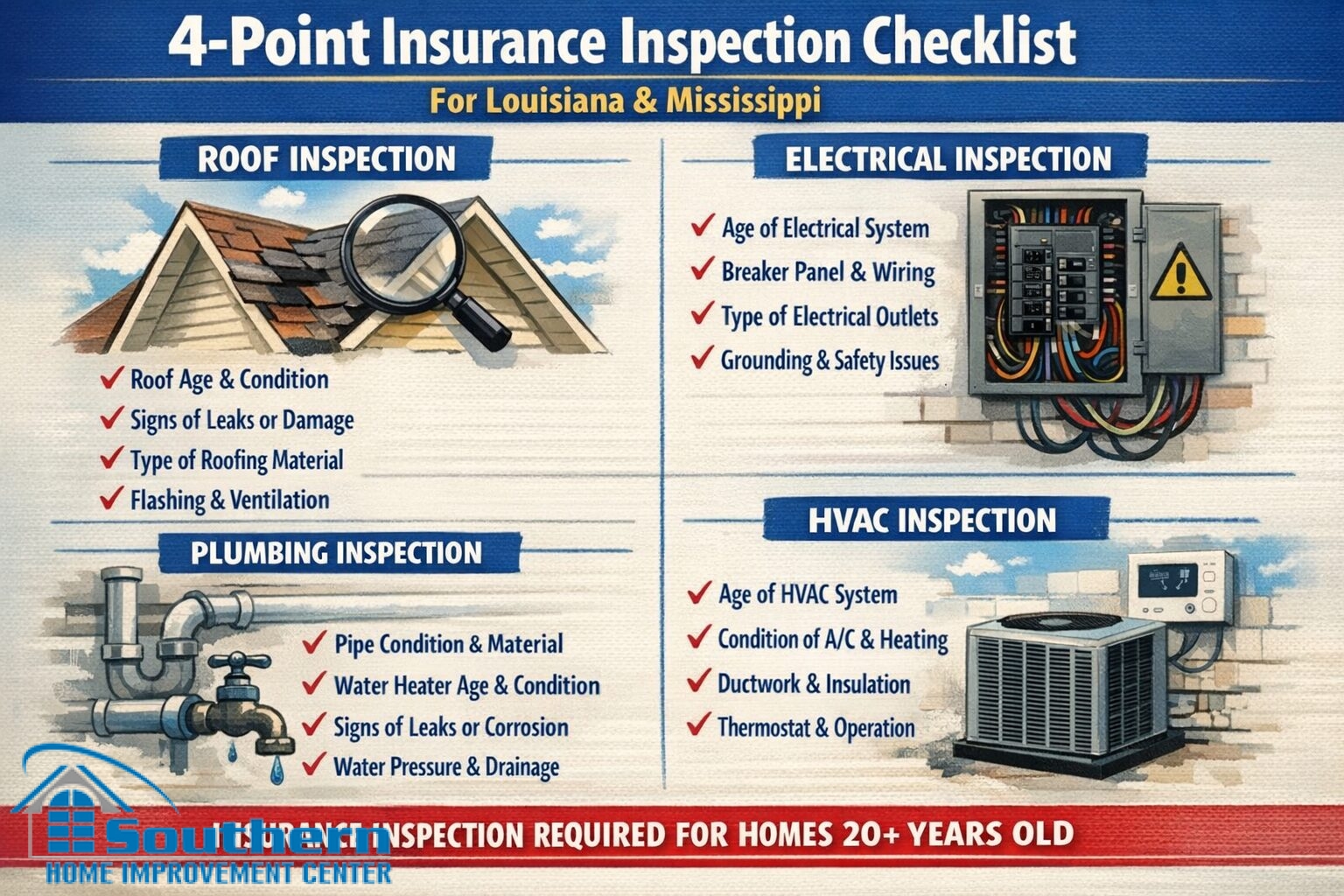
A 4-point insurance inspection is a focused report on four major home systems: the roof, electrical, plumbing, and heating and cooling. An insurance company may request the report before issuing, renewing, or changing a homeowners policy, especially when it needs more information about an older home.
The inspector documents visible conditions; the insurance carrier makes the underwriting decision. There is no single “passing score” that applies to every company. Before scheduling, ask your agent or carrier which form it requires, how recent the report must be, and what inspector credentials it will accept.
Quick answer
What Is a 4-Point Insurance Inspection?
It is a limited, visual inspection designed to give an insurer current information about the condition, age, and visible risks of the home’s roof, electrical, plumbing, and HVAC systems. It is narrower than a full home inspection and is prepared for insurance underwriting rather than for a complete evaluation of everything in the home.
A 4-point report does not guarantee coverage, a particular premium, or policy renewal. It also does not replace repairs, permits, specialist evaluations, or other documents a carrier may request after reviewing the report.
The four systems
What a 4-Point Inspection Usually Documents
The exact checklist and acceptance criteria depend on the insurer. These are the categories commonly recorded in a four-point report, not a promise that every carrier asks the same questions.
Roof
Roof-covering type, estimated or documented age, visible condition, missing or damaged materials, penetrations, flashing, signs of leakage, and areas that may need further evaluation.
Electrical
Main service and panel information, visible wiring types, overcurrent protection, grounding observations, exposed or unsafe-looking components, and conditions that may require a licensed electrician.
Plumbing
Visible supply and drain materials, active leaks, corrosion, fixture connections, shutoff access, water-heater information, and conditions that may require a licensed plumber.
HVAC
System type, approximate or documented age, visible condition, evidence of leakage or damage, and basic operation when it can be checked safely within the requested inspection scope.
Use the correct report
4-Point Inspection vs. Other Home and Roof Reports
These services answer different questions. Confirm the exact document requested before paying for an inspection that may not satisfy the carrier.
Prepare without concealing conditions
Before the Inspector Arrives
The goal is to provide safe access and accurate records. Do not cover stains, hide leaks, open an electrical panel, climb onto the roof, or attempt electrical, plumbing, HVAC, or roofing repairs outside your experience and licensing.
-
1
Get the Carrier’s Instructions
Request the required form, submission deadline, report-age limit, photo requirements, and acceptable inspector qualifications in writing.
-
2
Choose an Accepted Inspector
In Louisiana, verify the inspector through the Louisiana State Board of Home Inspectors when the work falls within a licensed home inspection. In either state, confirm carrier acceptance before booking.
-
3
Gather Dates and Records
Collect permits, paid invoices, warranties, installation dates, prior inspection reports, and documentation for roof, electrical, plumbing, HVAC, and water-heater work.
-
4
Provide Safe Access
Clear reasonable access to the electrical panel, attic opening, HVAC equipment, water heater, plumbing shutoffs, and other visible components the inspector has agreed to review.
-
5
Document Known Repairs
Keep before-and-after photos and invoices together. If an old stain remains after a repaired leak, preserve proof of the repair rather than painting over the evidence before inspection.
-
6
Address Active Safety or Water Problems
Use the appropriate qualified contractor for active leaks, unsafe wiring, plumbing leaks, or nonfunctioning equipment. Ask whether the insurer will require reinspection after correction.
The roof portion
Roof Findings That Often Need Follow-Up
Gulf Coast roofs face wind-driven rain, high heat, humidity, tropical weather, and repeated repair cycles. A report may prompt additional questions when the roof’s age is unclear or visible conditions suggest current water-entry risk.
- Active leakage or interior staining without repair documentation
- Missing, lifted, cracked, loose, or heavily worn roof-covering materials
- Damaged flashing at walls, chimneys, valleys, skylights, or roof transitions
- Cracked pipe boots, open penetrations, or exposed fasteners
- Repeated patches without a clear repair scope or completion record
- Soft, deteriorated, or visibly stained decking at accessible locations
- Conflicting roof-age information or no supporting installation records
Relevant SHIC resources
Roof Documentation and Preparation Guides
After the inspection
What If the Report Identifies a Problem?
A home inspector records observed conditions; the insurer decides whether it needs repairs, additional documentation, different terms, or another review. Treat the report and the underwriting response as two separate documents.
Read the Exact Finding
Identify which system, component, photo, or missing record created the question.
Ask What the Carrier Requires
Confirm whether it wants repair, replacement, specialist evaluation, an invoice, new photos, or an amended report.
Use the Correct Trade
Have roofing, electrical, plumbing, or HVAC work completed by the appropriate qualified professional.
Resubmit Complete Proof
Send the requested photos, paid invoice, contractor statement, permit record, or follow-up inspection before the deadline.
Homeowner questions
4-Point Insurance Inspection FAQ
Does every older home in Louisiana or Mississippi need a 4-point inspection?
No. A carrier may request one based on its underwriting rules, the home, policy type, available records, or other risk information. Ask your agent or carrier whether the report is required for your application or renewal.
Is there one standard 4-point form used by every insurance company?
No universal form or acceptance standard applies to every carrier. Obtain the correct form and submission instructions before hiring the inspector.
Can a house pass or fail a 4-point inspection?
The inspector reports observed conditions. The insurance company reviews those findings and makes the underwriting decision. A report can identify deficiencies, but the carrier determines what documentation or correction it will accept.
Can I prepare the formal report myself?
Homeowner photos and records can support the file, but they may not replace the formal report. Ask the carrier who is authorized to complete and sign its required form.
Does a new roof automatically satisfy the roof section?
No automatic approval should be assumed. Installation records, permits, current visible condition, flashing, penetrations, and evidence of leakage may still matter to the inspector or carrier.
What if I do not know the roof’s age?
Gather any permit record, paid invoice, warranty, seller disclosure, prior report, or dated installation photo you can locate. The inspector can document observed condition, but the carrier decides whether the available age evidence is sufficient.
Can a roof condition report replace a 4-point inspection?
Only if the insurance company says it will accept that document for the request. A roof condition report covers the roof, while a four-point report also addresses electrical, plumbing, and HVAC.
Does SHIC complete the entire 4-point inspection?
No. SHIC helps with the roofing portion: observed roof condition, photo documentation, and repair-versus-replacement planning. The complete four-system report must be handled by a professional accepted by the insurer.
Roof documentation for insurance review
Need Help With a Roof Finding?
Send SHIC the carrier’s roof request, inspection finding, photos, and deadline. We can review the roofing concern, document visible conditions, and prepare a practical repair or replacement scope when needed.
Request a Roof Evaluation