
Fiber Cement Siding • Louisiana & Mississippi Gulf Coast
Fiber Cement & Hardie Plank Siding in Louisiana and on the Mississippi Gulf Coast
James Hardie® fiber cement siding is a practical option for Gulf Coast homeowners who want the look of painted wood with a more stable, noncombustible cladding material. The finished result, however, depends on much more than the boards: wall condition, water-resistive barrier, flashing, clearances, fastening, trim, paint or factory finish, and drainage all have to work together.
Southern Home Improvement Center (SHIC) installs Hardie Plank and other fiber cement siding systems across Southeast Louisiana and the Mississippi Gulf Coast. This guide explains where fiber cement fits, what proper installation should include, how ColorPlus® differs from field-applied paint, and what to compare before requesting a proposal.

Understand the Material
Why Gulf Coast Homeowners Consider Fiber Cement Siding
Fiber cement siding is manufactured from cementitious material, cellulose fibers, and other components formed into planks, panels, shingles, and trim. It is heavier and more rigid than vinyl, and it is commonly selected when the homeowner wants a painted-board appearance without returning to traditional wood siding.
The material has meaningful advantages, but each one needs to be understood correctly:
Hot, Humid Climate Option
James Hardie’s HZ10® products are formulated for southern regions exposed to heat, humidity, strong sun, coastal air, and tropical weather.
Moisture-Damage Resistance
Fiber cement resists rot and moisture-related damage better than untreated wood, but it still requires correct clearances, flashing, drainage, and sealed or finished cut edges.
Noncombustible Cladding
Hardie fiber cement siding is classified as noncombustible cladding. Applied paint and coatings have separate characteristics and can still be damaged by heat or flame.
Architectural Finish
Lap siding, vertical panels, board-and-batten layouts, shingle accents, and coordinated trim can create a more substantial painted exterior.
Engineered for Climate®
What HZ10 Means for Louisiana and Coastal Mississippi
James Hardie divides much of the United States into climate zones. HZ10 products are intended for hot, humid southern conditions, while HZ5 products address colder climates with freeze-thaw exposure. For homes in Louisiana and on the Mississippi Gulf Coast, the locally available HZ10 product line is generally the relevant starting point.
HZ10 does not mean every product, profile, fastener pattern, and wall assembly has the same wind-load capacity. A contractor still needs to use the current technical documents for the exact plank, panel, shingle, trim, or soffit product. Building height, wall zone, framing or sheathing, exposure, fasteners, and attachment method can affect the approved installation.
| Gulf Coast condition | What fiber cement contributes | What installation must still address |
|---|---|---|
| Heat and strong sun | A rigid cladding that does not soften or melt like vinyl can under concentrated heat. | Correct product zone, finish, clearances, joint details, and maintenance. |
| Humidity and repeated rain | Resistance to rot and moisture damage compared with traditional wood siding. | WRB, flashing, sealed cuts, drainage paths, roof runoff, and separation from wet surfaces. |
| Wind exposure | Product-specific wind-load performance when installed in an approved configuration. | Required design pressure, wall zone, framing, fastener type, spacing, penetration, and edge distances. |
| Salt-air environment | A fiber cement board that does not corrode. | Compatible corrosion-resistant fasteners, metal flashing, accessories, paint, and maintenance. |
| Fire exposure | Noncombustible cladding that does not add fuel in the way some combustible materials can. | The rest of the wall, soffit, vents, windows, roof, coatings, and defensible-space strategy. |

The Wall System Matters
What Proper Hardie Plank Installation Should Include
Fiber cement is less forgiving of shortcuts than its finished appearance suggests. Boards need a flat, sound substrate and accurate layout. Water must be able to drain at every horizontal transition. Fasteners and edge distances must match the current instructions, and cut edges need the specified treatment. These details affect appearance, service life, and warranty eligibility.
-
Define the replacement scope
Identify which elevations, gables, dormers, porch walls, garage areas, soffit, fascia, trim, and penetrations are included. Full and partial replacement require different transition planning.
-
Remove material and inspect the wall
When tear-off is included, the exposed wall can be checked for soft sheathing, rot, previous leaks, uneven surfaces, and attachment conditions. Concealed repairs should be documented before additional work is authorized.
-
Integrate the water-resistive barrier
Housewrap or another approved WRB must connect correctly with window, door, penetration, roof-to-wall, and horizontal flashing details. Fiber cement is not the drainage plane.
-
Plan required clearances
Clearance keeps board edges away from soil, standing water, roof runoff, and surfaces that stay wet. Current HZ10 guidance commonly calls for at least 6 inches above finished grade and at least 1 inch above roof surfaces or decks, with detail-specific requirements controlling.
-
Use the approved fastening schedule
Nails or screws, framing penetration, spacing, blind- or face-nailing, and joint placement must match the exact product and required design pressure. “More nails” is not a substitute for the approved pattern.
-
Flash joints and horizontal transitions
Butt joints, window heads, band boards, roof intersections, decks, masonry transitions, and other horizontal surfaces need the manufacturer-specified flashing and gaps. Drainage openings should not be sealed shut with caulk.
-
Finish cuts, joints, and trim correctly
Field cuts and exposed edges require the specified primer, paint, sealant, flashing, or factory touch-up method. The correct treatment depends on the product and detail; one universal caulking rule does not apply everywhere.
-
Complete final quality control
Review course alignment, fasteners, clearances, flashing, trim joints, paint or touch-up, penetrations, cleanup, and the written project scope before closeout.
Details homeowners can see
- Straight courses and consistent reveals
- Balanced plank layout around windows and doors
- Clean corner, soffit, fascia, and brick transitions
- Consistent trim widths and finished cut edges
Details the proposal should document
- Product line, profile, climate zone, and finish
- WRB, flashing, sheathing repair, and fastening scope
- Clearances at grade, roofs, decks, slabs, and gutters
- Warranty documents and workmanship coverage
Build the Exterior as a System
Hardie Siding Profiles, Textures, and Finish Options
“Hardie board” is often used as a general term, but the product family includes several shapes and installation systems. Availability varies by market, color collection, texture, and product zone, so final selections should be confirmed before the proposal is signed.
Hardie Plank Lap Siding
Horizontal courses create a traditional painted-board exterior. Plank width and exposure determine the shadow line and visual scale of the home.
Hardie Panel & Battens
Vertical panels combined with battens can produce a board-and-batten appearance on full elevations, gables, dormers, or selected accents.
Hardie Shingle Accents
Shingle-style fiber cement can add texture to gables, bays, and upper elevations without committing the full home to a busier profile.
Smooth Finish
A cleaner surface with crisp lines that suits contemporary, transitional, and updated traditional exteriors.
Select Cedarmill®
A wood-grain texture for homeowners who want a more traditional look while using a fiber cement substrate.
Hardie Trim & Soffit
Coordinated trim and soffit complete corners, openings, eaves, porch ceilings, fascia transitions, and board-and-batten layouts.
ColorPlus® or Field-Painted Fiber Cement?
ColorPlus Factory Finish
ColorPlus is applied and cured at the factory for controlled coverage and color consistency. It reduces field-painting variables, but installation cuts and touch-up still need the approved ColorPlus method.
Best fit: homeowners who find an available factory color they want and value a manufacturer-backed finish system.
Primed and Field-Painted
Primed boards are finished after installation, allowing broader paint-color choice and a uniform final coat over siding, trim, fasteners, and field details.
Best fit: custom palettes, exact brick or trim coordination, and projects where the selected color is not locally available in ColorPlus.
Completed SHIC Project • Gramercy, LA
Navajo Beige Hardie Siding on a Home and Garage
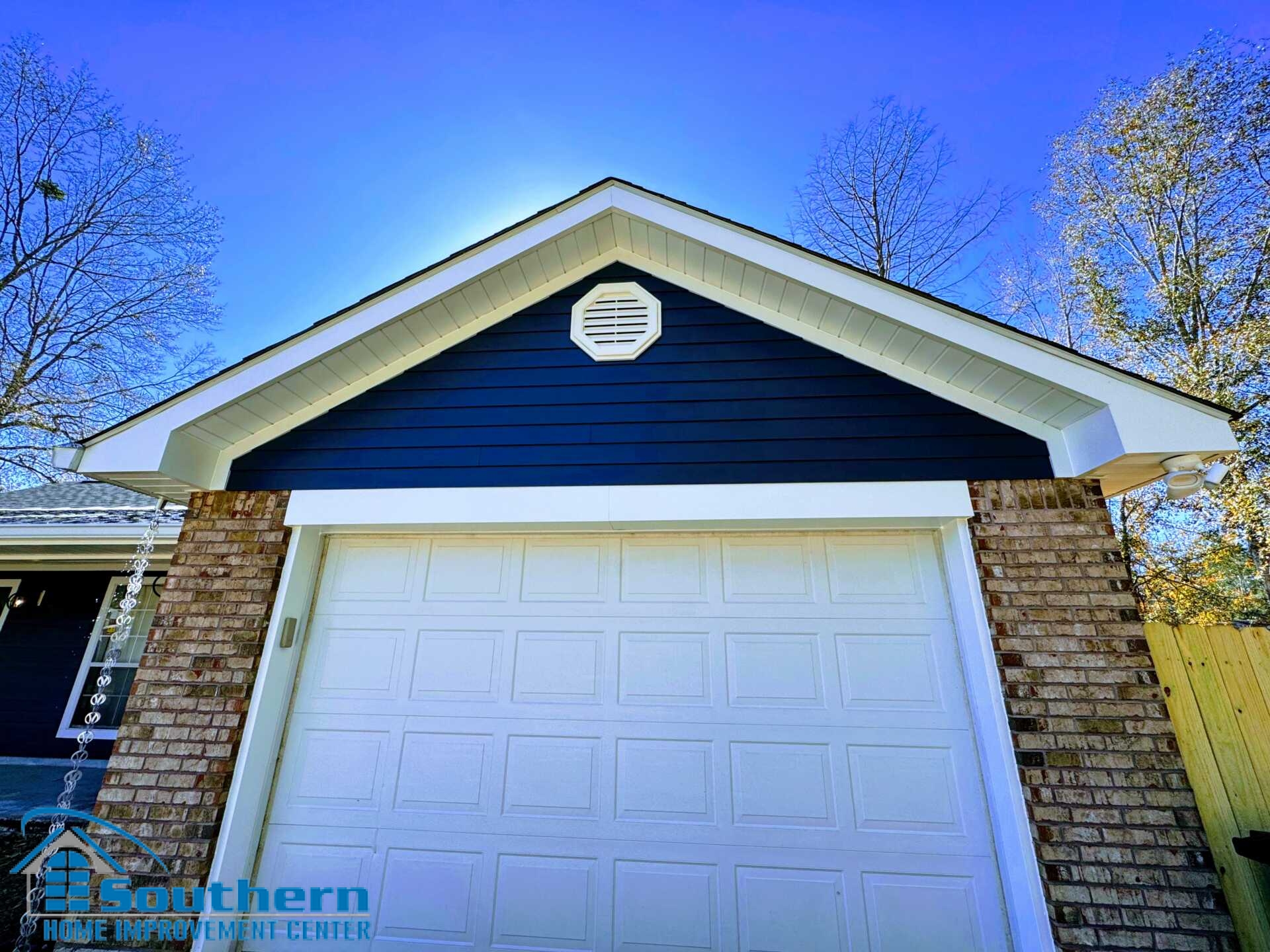
For this Gramercy project, SHIC removed existing vinyl siding from the house and garage and installed James Hardie ColorPlus 8¼-inch Cedarmill planks in Navajo Beige over Certa-Wrap. The finish package included White Rustic 5/4 trim around nine windows and two garage doors, plus vinyl-coated aluminum capping at two door frames.
The project shows why a siding proposal should cover more than the main wall field. The warm neutral siding works with the existing brick base, while the coordinated window, garage, and door details keep the house and detached areas visually consistent.
See the complete Gramercy Hardie siding project
Two Valid Options, Different Priorities
Hardie Plank vs. Vinyl Siding for Gulf Coast Homes
Fiber cement is not automatically the right answer for every house, and vinyl is not automatically a lesser system. The better choice depends on budget, architecture, wall condition, exposure, desired finish, maintenance expectations, and the installation proposal.
| Comparison | Hardie fiber cement | Vinyl siding |
|---|---|---|
| Exterior character | Rigid painted-board appearance with lap, panel, shingle, and trim options. | Lightweight interlocking panels with many lap profiles, colors, and accent styles. |
| Upfront cost | Usually higher because of material weight, cutting, fastening, trim, and finishing labor. | Usually lower for a comparable wall area and simpler replacement scope. |
| Finish maintenance | Factory or field-applied coating must be inspected and eventually maintained or repainted. | Through-color panels do not require routine repainting, though cleaning and repairs remain necessary. |
| Fire behavior | Hardie fiber cement is noncombustible cladding. | Vinyl is combustible and can soften or melt when exposed to sufficient heat. |
| Moisture strategy | Requires WRB, flashing, clearances, finished edges, and controlled drainage. | Also requires WRB and flashing; panel openings allow incidental water to drain. |
| Storm performance | Depends on product, design pressure, substrate, fasteners, spacing, and wall zone. | Depends on panel rating, locking system, substrate, fasteners, starter strip, and accessories. |
| Repairs | A damaged board can often be replaced, but matching paint and working around joints may add labor. | A damaged panel can often be replaced if a compatible profile and color remain available. |
For a broader material decision that also includes siding profiles and other exterior options, use SHIC’s Best Siding for Louisiana Homes guide. This page remains focused on the fiber cement service itself.
Build a Comparable Scope
What Affects Hardie Siding Cost in Louisiana and Mississippi?
Hardie siding is normally priced as a complete installation, not as boards alone. A low square-foot number can exclude tear-off, wall repairs, WRB, flashing, trim, soffit, fascia, painting, access, disposal, or permits. Those exclusions can matter more than a small difference in material price.
For detailed budgeting questions without turning this service page into a second pricing article, see Siding Replacement Cost in Louisiana and Mississippi.
Read the Fine Print
Hardie Product and ColorPlus Warranty Basics
Current James Hardie materials describe a 30-year transferable, non-prorated limited substrate warranty for eligible siding, trim, and soffit products. Eligible ColorPlus finishes have separate 15-year limited finish coverage. These periods describe manufacturer warranties, not a promise that every component will remain maintenance-free or that storm damage will be covered.
30-Year Limited Substrate Warranty
Applies only to eligible Hardie products and remains subject to the current warranty document, approved installation, exclusions, and claim requirements.
15-Year ColorPlus Finish Warranty
Separate limited coverage applies to eligible factory finishes. Field-applied paint and contractor workmanship are not the same warranty.
The controlling documents are the warranties issued for the exact product and installation date. Eligibility can depend on proper storage, handling, installation, finishing, maintenance, proof of purchase, exclusions, transfer requirements, and the claim process. Before signing, ask which product warranty applies, whether the finish has separate coverage, what SHIC’s workmanship coverage includes, and which documents you will receive after completion.
Proposal Checklist
What to Ask Before Hiring a Fiber Cement Siding Contractor

Service Area
Hardie Siding Installation Across Southeast Louisiana and the Mississippi Gulf Coast
SHIC serves homeowners in New Orleans, Metairie, Kenner, Jefferson, Slidell, Lacombe, Mandeville, Covington, Madisonville, Baton Rouge, Prairieville, Gonzales, Gramercy, and other Southeast Louisiana communities, along with Bay St. Louis, Gulfport, Biloxi, and qualifying projects across the Mississippi Gulf Coast.
Product availability, wind-design requirements, permits, historic-district or HOA review, and site conditions vary by address. The estimate should be based on the actual property and selected product rather than a universal regional package. Confirm coverage for your location on the SHIC Service Areas page.
Frequently Asked Questions
Hardie Plank Siding FAQ
Is Hardie Plank a good siding choice for Louisiana?
It can be. HZ10 products are formulated for hot, humid southern climates. The best fit still depends on the home, exposure, budget, appearance goals, wall condition, and whether the contractor follows the current product instructions.
Is Hardie siding hurricane-proof?
No. Fiber cement siding cannot guarantee that a home will avoid damage in a hurricane. Wind performance depends on the exact product, required design pressure, wall zone, substrate, fasteners, spacing, and installation configuration. Flying debris and failure of other building components create separate risks.
Is Hardie siding waterproof?
No. It is moisture-resistant exterior cladding, not the water-resistive barrier. Housewrap or another approved WRB, flashing, drainage, clearances, and properly finished edges remain necessary.
Does Hardie siding rot or attract termites?
Fiber cement does not provide the same food source as wood and is manufactured to resist moisture-related damage. Persistent wetting, improper clearance, damaged finish, or incorrect installation can still cause problems that require correction.
Does Hardie Plank need to be painted?
Primed products require an approved field-applied finish. ColorPlus products arrive with a factory-applied finish, but cut edges and installation marks must be handled with the approved touch-up process. Any coating will eventually need inspection and maintenance.
What is the difference between Smooth and Cedarmill?
Smooth has a cleaner, more uniform face. Select Cedarmill has a wood-grain texture. The choice is primarily architectural, although availability can vary by product, width, finish, color, and region.
Can Hardie siding be installed over existing siding?
That depends on the existing material, wall flatness, local requirements, manufacturer instructions, and whether the substrate and flashing can be properly evaluated. Tear-off often provides a better opportunity to find concealed damage and correct the wall assembly.
Can only one damaged elevation be replaced?
Sometimes. Partial replacement can make sense when transitions, profiles, colors, trim, and water-management details can be resolved cleanly. The estimate should explain how the new work will meet the retained exterior.
How should Hardie siding be cleaned?
Use gentle methods appropriate to the finish, such as a garden hose and a soft nonmetal brush. Avoid aggressive pressure washing that can damage paint, joints, sealant, or flashing details.
How long does a Hardie siding project take?
Timeline depends on home size, tear-off, concealed repairs, height, access, weather, trim complexity, finish method, permits, and inspections. A site-specific proposal should provide the realistic sequence and schedule.
Does homeowners insurance pay for Hardie siding?
Insurance coverage depends on the policy, cause of loss, exclusions, deductible, existing condition, and insurer’s determination. A contractor can inspect and document visible damage but cannot guarantee coverage or a claim outcome.
Free Siding Estimate
Planning Hardie Plank or Fiber Cement Siding?
SHIC can inspect the existing exterior, review product and finish options, and prepare a written scope for wall preparation, WRB, flashing, siding, trim, soffit, fascia, and related exterior details.
(985) 643-6611 New Orleans / Jefferson
(504) 833-1835 Baton Rouge
(225) 766-4244 Mississippi Gulf Coast
(228) 467-7484