
July 2026 Gulf Coast storm update
After Tropical Storm Bertha: Roof Checks for Louisiana and the Mississippi Gulf Coast
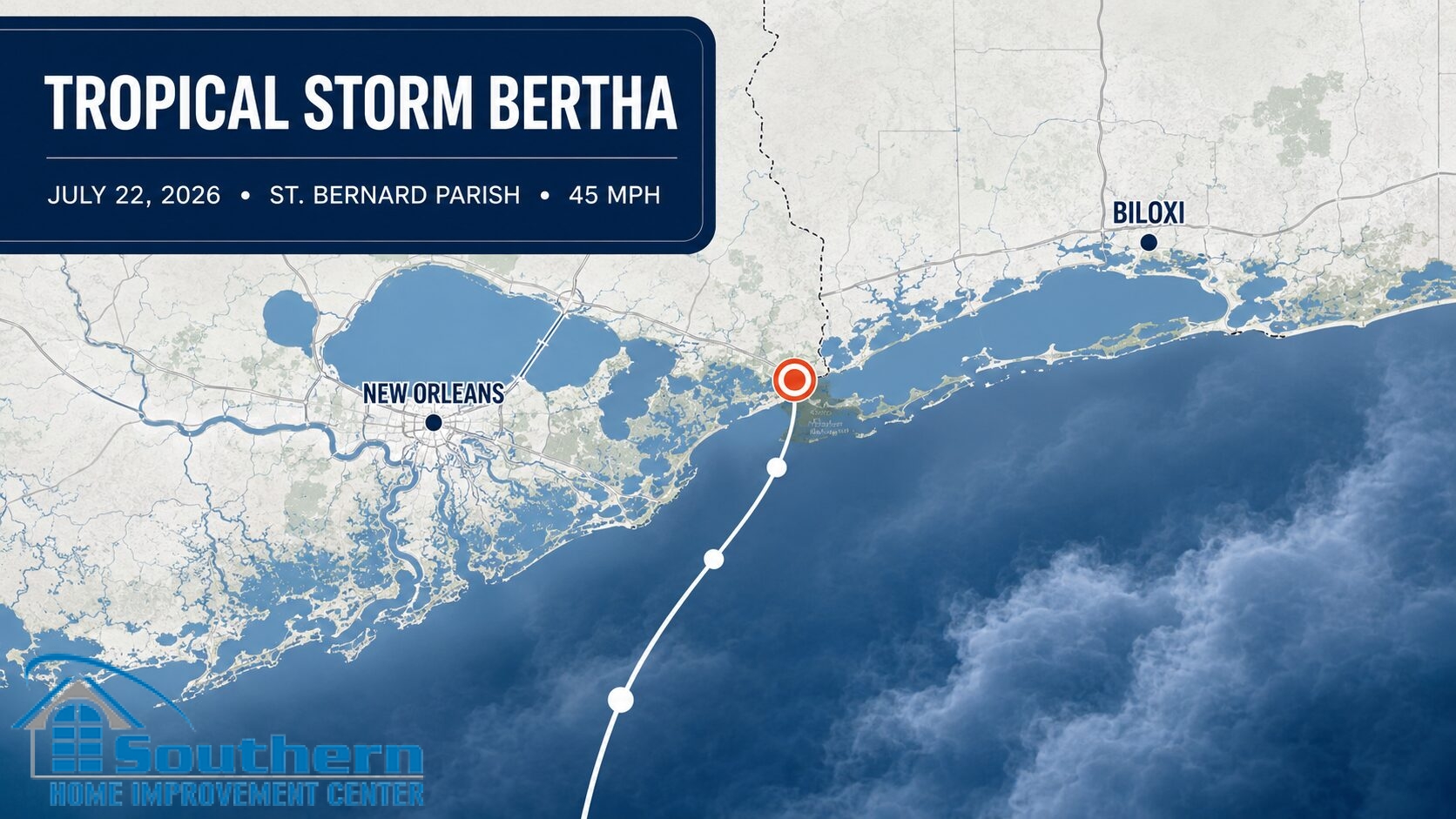
Tropical Storm Bertha made landfall in St. Bernard Parish on July 22, 2026, with estimated maximum sustained winds of 45 mph and higher gusts. The center crossed the coast near the Biloxi Wildlife Management Area, about 40 miles east of New Orleans and 45 miles southwest of Biloxi, Mississippi.
Regional reports indicated limited widespread damage, but that does not answer what happened at an individual home. Wind-driven rain, gusts, standing water, moving debris, and overflowing drainage can expose an existing weakness or create a localized opening that is not obvious from the street. Homeowners should look for changes, document them safely, and match the next step to the condition they actually find.
Quick answer
What Should Homeowners Check After Bertha?
Start inside the home. Look for a new ceiling stain, damp attic insulation, dripping near a vent or chimney, bubbling paint, musty odor, or water around windows and exterior doors. Then inspect the property from the ground for displaced shingles, loose ridge material, damaged roof edges, leaning gutters, clogged downspouts, fallen branches, shifted siding, or movement in an attached patio cover.
Do not climb onto a wet, steep, metal, damaged, or unfamiliar roof. If there is active leaking, visible displacement, a sagging ceiling, a fallen limb, exposed decking, or an electrical concern, keep people away from the area and request professional help.
Official event record
What Happened When Tropical Storm Bertha Reached Louisiana?
The National Hurricane Center reported Bertha’s Louisiana landfall at 2:00 p.m. CDT on Wednesday, July 22. Its location placed the center close to homes across southeastern Louisiana and the western Mississippi Gulf Coast, while the storm’s broader wind and rain field extended beyond the exact track.
Bertha made its initial Gulf Coast landfall on Wednesday afternoon.
The center crossed near the Biloxi Wildlife Management Area.
The NHC estimated higher gusts near the time of landfall.
The reported center was approximately 40 miles east of New Orleans and 45 miles southwest of Biloxi.
A storm’s maximum sustained wind is a regional meteorological measurement, not a property-level damage report. Roof age, installation, tree exposure, roof geometry, previous repairs, drainage, local gusts, and wind direction can produce different results from one home to the next.
Lower intensity does not mean identical impact
Why a 45 mph Tropical Storm Can Still Reveal Roof Problems
Bertha was not a major hurricane, and homeowners should not assume severe structural damage occurred simply because the system was named. The more practical question is whether the combination of gusts and wind-driven rain changed the condition of the home or exposed a weakness that was already developing.
Wind Can Reach Roof Edges First
Eaves, rakes, ridge caps, starter courses, drip edge, and previously loosened shingles can be more vulnerable than the middle of a roof plane.
Rain Can Enter Small Openings
A worn pipe boot, flashing gap, unsealed fastener, lifted shingle, or roof-to-wall transition may leak only when rain approaches from a certain direction.
Drainage Can Back Up
Leaves, roof granules, twigs, and other debris can restrict gutters or downspouts and send water toward fascia, soffit, walls, or the foundation.
Existing Wear Can Become Visible
A tropical system may reveal an aging seal, old repair, deteriorated flashing detail, or moisture path that did not begin with this event.
Safe post-storm review
Bertha Roof and Exterior Checklist
Use this sequence to review the home without creating additional risk or disturbing evidence that may be useful later.
- 1
Check Ceilings and Interior Walls
Look for new discoloration, peeling paint, soft drywall, dripping, damp trim, or an odor that was not present before the storm. Mark the edge of a stain lightly with a pencil and note the date so later movement is easier to identify.
- 2
Review the Attic Only if It Is Safe
From a stable access point, look for damp insulation, darkened decking, water trails, daylight, or moisture near vents, pipes, chimneys, valleys, and roof-to-wall transitions. Do not step between framing members or touch wet wiring.
- 3
Walk the Property From the Ground
Look for shingles, ridge pieces, fasteners, flashing, vent parts, branches, or other roofing material on the ground. Photograph where each item was found before moving it when practical and safe.
- 4
Scan Roof Planes, Ridges, Edges and Penetrations
Use binoculars or a zoom camera from the ground. Watch for a changed roof line, missing or shifted material, lifted edges, damaged ridge caps, exposed underlayment, displaced flashing, or a vent that no longer sits correctly.
- 5
Check Gutters, Downspouts, Fascia and Soffit
Confirm gutters remain attached and properly sloped. Look for overflow marks, separated joints, crushed downspouts, loose fascia wrap, displaced soffit panels, and runoff collecting near doors, walkways, or the foundation.
- 6
Review Siding, Windows and Exterior Doors
Check for shifted panels, open seams, damaged trim, cracked sealant, water at sills, and staining below windows. A leak near an exterior wall does not always originate directly above the interior stain.
- 7
Inspect Attached Outdoor Structures
From the ground, review patio covers, screen rooms, carports, awnings, gutters, posts, beams, wall connections, and drainage. Stop using the area if anything appears loose, twisted, separated, or unstable.
- 8
Watch the Next Rain
Some problems become visible only during another rainfall. Recheck ceilings, attic areas, windows, doors, gutters, and drainage paths rather than assuming one dry day proves the building envelope is unchanged.
Create a clean property record
Document Conditions Before Cleanup or Permanent Repair
Take wide photos that establish the room or side of the house, then closer photos of the specific condition. Record the date, approximate time, location, when the issue was first noticed, and whether it changed during later rain.
Keep copies of temporary-repair receipts, contractor findings, estimates, policy correspondence, and photographs. If emergency work is necessary to prevent additional damage, document the condition before and after the temporary work whenever it is safe to do so.
A roofing contractor can document visible conditions and prepare a repair or replacement scope. The insurer determines coverage, cause-of-loss treatment, deductible application, and claim payment under the policy.
Match the response to the condition
Monitor, Inspect, Repair or Stabilize?
Not every home needs roof work after Bertha. The correct next step depends on what changed, whether water is entering, and whether a component is unsafe or exposed.
No New Warning Signs
If there is no visible change, no new interior moisture, no displaced material, and drainage is working, keep photographs and check again during the next rain.
Uncertain or Hidden Condition
Request an evaluation when a stain, odor, attic moisture clue, roof age, fallen branch, or hard-to-see roof area creates a reasonable concern but there is no immediate emergency.
Localized Correctable Problem
A targeted repair may be appropriate when the affected component is identifiable, surrounding materials remain serviceable, and the repair can restore a dependable detail.
Active Leak or Exposed Area
Emergency protection may be necessary when water is entering, roof material is missing, decking is exposed, or a damaged component could move or fall.
Repair versus replacement
When Does a Post-Bertha Roof Problem Require More Than a Repair?
The storm name alone does not decide whether a roof should be repaired or replaced. The decision should consider the size and location of the affected area, roof age, remaining serviceability, prior repairs, deck condition, active leaks, flashing complexity, material availability, and whether multiple roof sections are failing.
Property-specific Gulf Coast review
Where Bertha Roof Checks Are Most Relevant
The exact track does not establish damage at every address. It does identify the communities where homeowners may reasonably compare current conditions with what they observed before the storm.
St. Bernard, Plaquemines & Eastern Orleans
Homes near the initial landfall area may have experienced combinations of gusts, coastal water, wind-driven rain, and drainage pressure.
Greater New Orleans & Jefferson
New Orleans, Metairie, Kenner, Harahan, and nearby communities should focus on new leaks, roof-edge changes, tree debris, gutters, and exterior openings.
Slidell, Lacombe & the Northshore
St. Tammany homeowners should review roof drainage, low areas, attached structures, tree exposure, and any stain or leak first noticed during Bertha.
Mississippi Gulf Coast
Bay St. Louis, Waveland, Diamondhead, Gulfport, Biloxi, Ocean Springs, and nearby areas should document property-specific conditions without assuming the storm affected every community equally.
Continue with the correct next step
SHIC Storm Roofing Resources
These pages separate the initial inspection, construction work, insurance documentation, and stronger reroofing paths.
Primary event sources
Official Tropical Storm Bertha Information
Storm facts and homeowner guidance in this update are based on official federal and Louisiana sources available after the event.
Homeowner questions after Bertha
Tropical Storm Bertha Roof FAQ
Where did Tropical Storm Bertha make landfall?
The National Hurricane Center reported that Bertha made landfall near the Biloxi Wildlife Management Area in St. Bernard Parish, Louisiana, at approximately 2:00 p.m. CDT on July 22, 2026.
How strong was Bertha at Louisiana landfall?
The NHC estimated maximum sustained winds of 45 mph with higher gusts. That number describes the storm at a regional scale and does not establish the wind or damage at an individual property.
Should I request an inspection if no shingles are missing?
Missing shingles are only one possible warning sign. A new ceiling stain, attic moisture, fallen branch, displaced vent, damaged flashing, loose roof edge, gutter movement, or leak that appears during the next rain may also justify an inspection.
Is it safe to climb onto the roof after a tropical storm?
Homeowners should avoid climbing onto wet, steep, metal, damaged, or unfamiliar roofs. Ground-level photographs, binoculars, and a qualified inspection are safer ways to evaluate areas that cannot be seen clearly.
Does a named-storm deductible automatically apply to every Bertha repair?
No assumption should be made without reviewing the policy and the insurer’s determination. Deductible application depends on policy language, reported cause, timing, coverage, and carrier review. Contact the insurer or agent for a property-specific answer.
Can a contractor determine whether insurance covers the damage?
A contractor can document visible conditions and prepare a construction scope. The insurance company interprets the policy, investigates the claim, determines covered loss, applies the deductible, and decides payment.
Does every roof leak after Bertha count as storm damage?
No. Some leaks may involve pre-existing wear, old repairs, deteriorated flashing, installation defects, maintenance issues, or a combination of conditions. The timing of a leak is useful information, but cause should be evaluated rather than assumed.
Can a FORTIFIED Roof be considered if Bertha-related damage leads to replacement?
Potentially. If replacement becomes necessary and the property is eligible, the project can be evaluated for a FORTIFIED Roof path. The evaluator, compliant scope, required photographs, approved components, and documentation process must be coordinated before concealed work begins.
Post-Bertha roof and exterior review
Request a Clear Property-Specific Evaluation
If you noticed a new leak, displaced roofing material, gutter damage, tree impact, attic moisture, or another exterior change during or after Bertha, contact Southern Home Improvement Center. Share the property address, when the issue appeared, whether water is still entering, and any photographs you can take safely.
Request a Free Estimate