
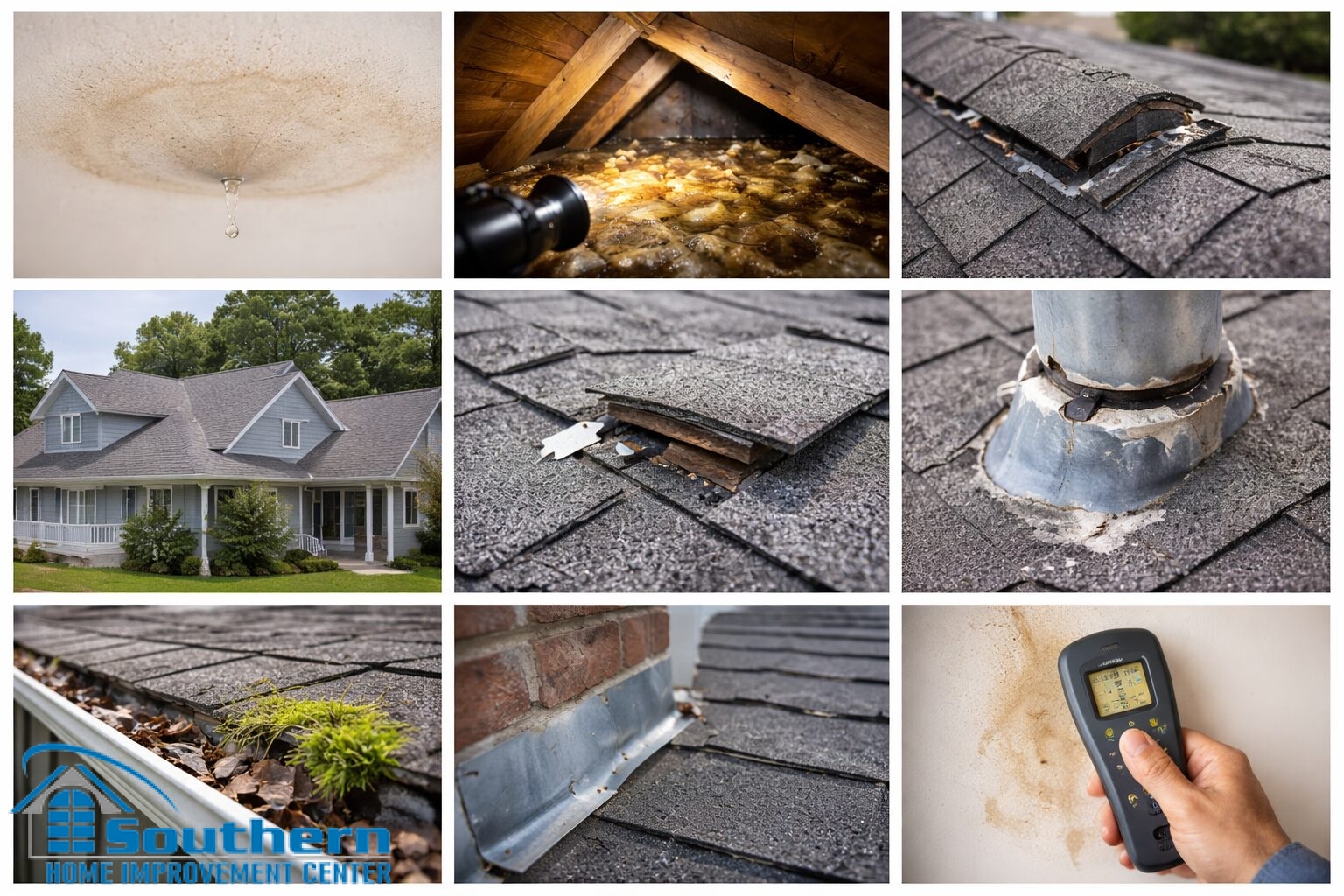
How to Find a Roof Leak Without Getting on the Roof (Gulf Coast Homeowner Checklist)
A roof leak can be confusing. The spot where you see a stain is often not the real source. Water can travel along rafters, decking, insulation, and even wiring before it shows up inside. That’s why guessing is expensive — and why a smart roof leak check starts with simple clues you can safely collect from inside and from the ground.
This guide is made for homeowners who like DIY. You will learn how to narrow down a roof leak, what photos to take, and what details matter most on Gulf Coast homes. In the last section, we’ll also explain when a roof leak should be handled by a professional — because safety and long-term performance matter.
First: a quick safety note
Do not get on the roof for a roof leak inspection. Wet shingles, steep slopes, and hidden soft spots can turn a small roof leak into a serious injury. This checklist is designed to help you diagnose a roof leak without climbing. If you cannot access an area safely, skip it and document what you can from below.
What you need for a simple roof leak check
Keep it basic. You do not need special tools to get useful roof leak evidence.
- A flashlight or headlamp
- Your phone (camera + notes)
- Painter’s tape (to mark spots)
- A bucket and a towel
- Optional: binoculars for a ground view
With these items, you can usually narrow a roof leak to one or two likely areas.
Step 1: Confirm it’s a roof leak (not plumbing or AC)
Before you chase a roof leak, rule out common “look-alikes.” This saves time and prevents the wrong repair.
- Plumbing: Stains near bathrooms, kitchens, laundry, or a second-floor plumbing wall may be a plumbing leak.
- AC: A wet ceiling near an air handler, return, or drain line can be AC condensation or a clogged drain.
- Roof: A stain that grows after rain, or after wind-driven rain, is often a roof leak.
If the stain grows after rain, treat it like a roof leak and move to the next step.
Step 2: Map the roof leak symptom inside the home
The best DIY move is to build a simple “symptom map.” A roof leak diagnosis is much easier when you know exactly where and when it shows up.
- Mark the center of the stain with painter’s tape.
- Note the room, the ceiling location, and the nearest exterior wall.
- Write down when the roof leak appears: heavy rain, light rain, wind-driven rain, or long steady rain.
- Take two photos: wide shot (room context) and close-up (detail).
This simple map helps you connect the roof leak symptom to the most likely roof area above.
Step 3: If it’s safe, check the attic for roof leak trails
Only do this if your attic access is safe and comfortable. If your attic is too hot, too tight, or has visible hazards, skip this and move to the ground inspection. A roof leak is not worth a risky attic crawl.
If you can safely look, here is what to check for a roof leak:
- Dark staining on the underside of roof decking
- Wet insulation or compressed insulation
- Rust on nails (especially in lines)
- Water marks on rafters that “point” uphill to the source
A roof leak trail often looks like a line, not a spot. Water tends to run along framing before it drops.
Step 4: Do a ground-level roof leak inspection outside
You can learn a lot about a roof leak without leaving the ground. Use binoculars or your phone zoom and walk the full perimeter.
- Look for missing, lifted, or creased shingles.
- Look for dark streaks under roof edges that suggest water overflow.
- Check around roof-to-wall areas (where a roof meets a taller wall).
- Scan roof valleys for debris lines or uneven shingle edges.
- Look at vent pipes and roof penetrations for cracked rubber boots (a common roof leak source).
- Watch gutters and downspouts after rain for overflow and splash.
Many roof leak problems on Gulf Coast homes are tied to flashing details, penetrations, and water control — not just shingles.
Step 5: Use the “timing test” to narrow the roof leak source
A roof leak behaves differently depending on where it starts. Use these patterns to narrow it down:
- Only during wind-driven rain: Often flashing, roof-to-wall transitions, or a side of the home where rain is pushed uphill.
- Only during heavy rain: Often overflow from valleys or gutters, or a bottleneck at a downspout drop.
- After long steady rain: Often a slow roof leak through underlayment, a small hole, or a saturated area.
- Not every storm: Often a roof leak that needs the “right” wind direction to show up.
If you match the timing to what you see outside, you can usually isolate a roof leak to one zone.
Most common roof leak sources on Gulf Coast homes
This is where most roof leak calls end up — even when shingles look fine from the street.
- Pipe boots: Cracked rubber around vent pipes is a classic roof leak trigger.
- Flashing at walls: Step flashing and counterflashing failures can cause a roof leak that shows far away inside.
- Valleys: Valleys handle high water volume. Debris or poor detailing can create a roof leak fast.
- Chimneys or skylights: Any penetration can become a roof leak if flashing is loose or aged.
- Gutters overflow: Overflow can soak fascia and push water where it shouldn’t go, creating a roof leak symptom inside.
- Drip edge and fascia line: A roof leak can start at the edge when water is not directed cleanly into the gutter.
Notice how many roof leak sources involve details and transitions — not just the main field of shingles.
DIY-safe actions that help (without “repairing” the roof leak on the roof)
If you want to do something helpful today, focus on safe steps that reduce damage and improve diagnosis.
- Catch dripping water and protect floors and furniture.
- Take clear photos of stains, attic trails (if safe), and any outside signs of a roof leak.
- Check downspout discharge: make sure water is moving away from the home.
- After rain, walk the perimeter and look for splash marks and overflow lines that suggest a water-control issue tied to the roof leak.
- Write down wind direction and storm intensity when the roof leak appears.
These steps don’t “fix” a roof leak, but they prevent secondary damage and make the real fix faster and more accurate.
What not to do for a roof leak
These are the common moves that often make a roof leak worse or hide the real problem.
- Do not climb onto the roof to “spot fix” a roof leak.
- Do not smear caulk or roof cement as a guessing game.
- Do not pressure wash shingles or blast valleys.
- Do not ignore repeat stains — a roof leak that repeats is telling you the source is still active.
A roof leak needs the right repair in the right location. Guessing usually leads to more repairs later.
What to send a professional so your roof leak gets solved faster
If you want a contractor to pinpoint the roof leak quickly, send a short, organized set of details.
- 2 photos of the interior stain (wide + close)
- 1 note describing when the roof leak happens (wind, heavy rain, long rain)
- Any attic photos of staining (only if safely accessible)
- Ground photos of the roof edge, valleys, vents, and gutters on the side where the roof leak shows up
This turns your roof leak call into a clear diagnostic request, not a vague complaint — and it saves time.
When a roof leak should be handled by pros
Some roof leak situations are not DIY. The work can involve height, steep slopes, hidden deck damage, or flashing systems that need correct installation. If any of the items below apply, it’s smarter to bring in a professional:
- The roof leak started after a storm, and you suspect wind damage.
- The roof leak appears in more than one area.
- You see sagging, soft spots, or repeated overflow at roof edges.
- You suspect flashing failure at a wall, valley, chimney, or penetration.
- You want the repair documented and warrantied.
In these cases, professional repair is usually safer and more cost-effective than trial-and-error.
Get the roof leak fixed the right way
If you’ve confirmed a roof leak (or you have strong signs of a roof leak), the best next step is a professional inspection that pinpoints the source and fixes it correctly — especially for Gulf Coast rain patterns. Southern Home Improvement Center (SHIC) can inspect the roof leak source, recommend the right scope, and handle repairs with proper flashing and water-control details. If storm impact is part of the story, start here: storm damage roof restoration. If water control is contributing to the roof leak symptoms, see: seamless gutters in Southeast Louisiana. For a proactive evaluation, consider: roof inspection.
To schedule help with a roof leak, call Southern Home Improvement Center (SHIC) at (985) 643-6611 or (225) 766-4244, to request an inspection and a written repair plan.