
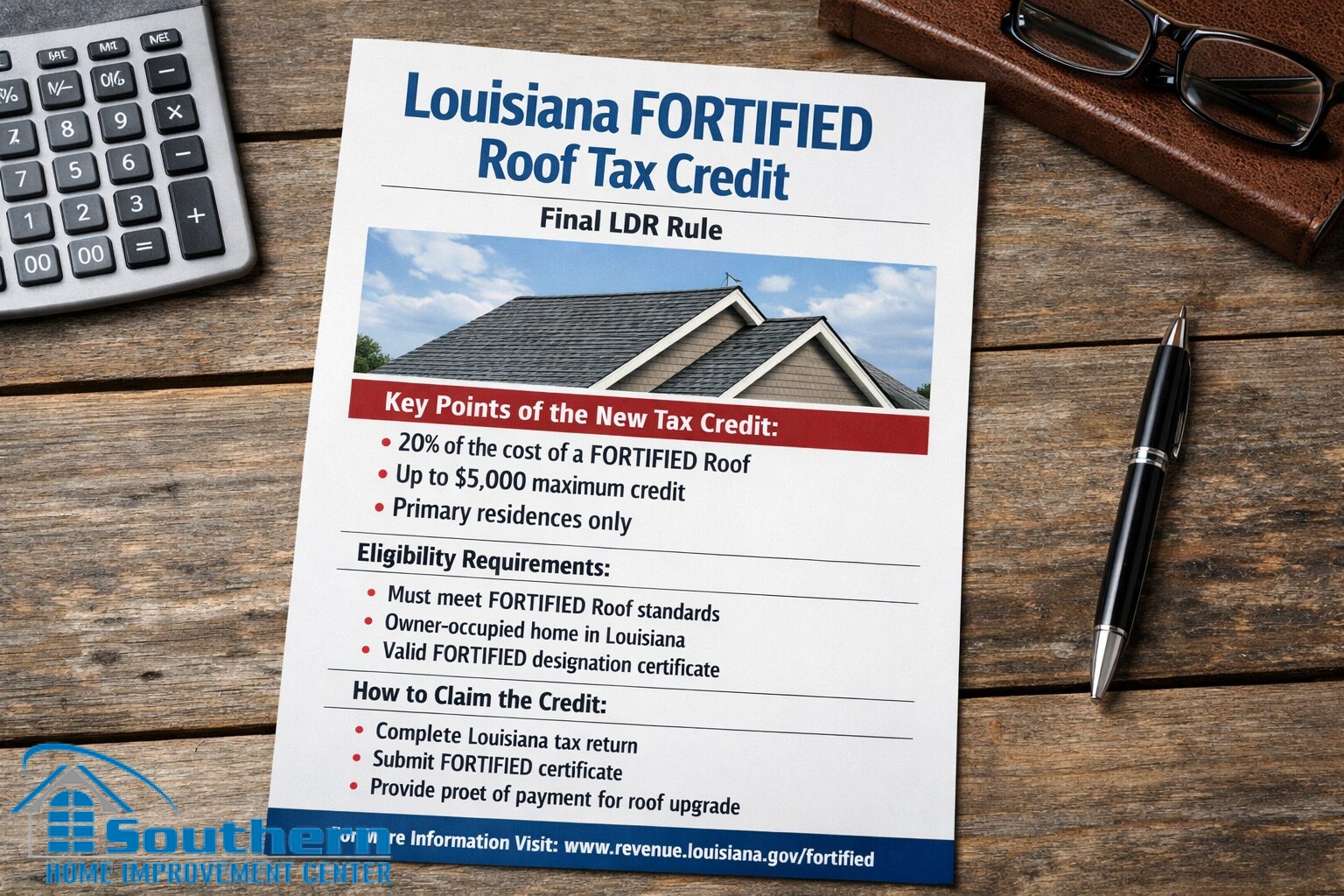
Louisiana FORTIFIED Roof Tax Credit: 2026–2027 Filing Rules & Current Status
The Louisiana FORTIFIED Roof Tax Credit is a nonrefundable state individual income tax credit for qualifying expenses on eligible homes that receive an IBHS FORTIFIED Roof designation. The maximum credit is up to $10,000 per qualifying residence, subject to eligibility, documentation, annual program limits, Louisiana Department of Revenue approval, and the homeowner's tax situation.
Roofs certified by IBHS in 2025: the application period ended June 30, 2026.
Roofs certified by IBHS in 2026: Louisiana Department of Revenue guidance states that homeowners can apply through LaTAP beginning January 1, 2027. Under Louisiana law, the application period runs from January 1 through June 30 of the calendar year following the year in which the credit is earned.
Southern Home Improvement Center does not determine tax-credit eligibility, approve applications, calculate a homeowner's tax liability, or guarantee that a homeowner will receive any particular tax benefit.
Updated August 8, 2026: This guide reflects current Louisiana law, Louisiana Department of Revenue guidance, and the currently effective LDR regulations governing the Louisiana FORTIFIED Roof Tax Credit Program.
Louisiana created the FORTIFIED Roof Tax Credit to provide a state income tax incentive for qualifying homeowners who upgrade an existing primary residence to the IBHS FORTIFIED Roof standard. The credit applies to qualified expenses incurred on or after July 1, 2025, and can equal qualified expenses up to the statutory maximum.
Current filing status
When Can Louisiana Homeowners Apply for the FORTIFIED Roof Tax Credit?
The filing period depends on the year in which the FORTIFIED Roof designation is issued by IBHS. Louisiana law states that the credit is earned when the roof is certified by IBHS, and the application period runs from January 1 through June 30 of the following calendar year.
Application period: January 1–June 30, 2026.
Current status: ClosedApplication period: January 1–June 30, 2027.
Current status: Future Filing WindowLouisiana law states that the credit is earned when IBHS certifies the roof. Homeowners should retain documentation showing the FORTIFIED designation date and verify their filing period with LDR or a qualified tax professional.
Credit amount and limits
How Much Is the Louisiana FORTIFIED Roof Tax Credit?
The credit is equal to qualifying expenses paid by the Louisiana resident taxpayer, subject to a maximum of $10,000 per qualifying residence.
The amount depends on qualified expenses accepted by LDR and the homeowner's individual circumstances. The credit is nonrefundable, meaning it is not automatically paid to the homeowner as cash.
If an approved credit exceeds the taxpayer's Louisiana income tax liability, Louisiana law allows the unused portion to be carried forward against subsequent tax liability for up to three years.
The program also has a statewide cap of $10 million in credits per fiscal year. Credits are issued on a first-come, first-served basis. If requests received on the same business day exceed remaining available credit capacity, Louisiana law provides for pro-rata allocation.
Basic statutory requirements
Which Louisiana Homes May Qualify?
Eligibility is determined under Louisiana law and LDR rules. Meeting one requirement does not by itself guarantee approval.
Louisiana Resident Taxpayer
The credit is available to qualifying Louisiana resident individual taxpayers.
Primary Residence
The property must be owned by the taxpayer and qualify as the taxpayer's primary residence.
Homestead Exemption
The qualifying property must have a homestead exemption.
IBHS FORTIFIED Designation
The completed roof must receive the required IBHS FORTIFIED Roof certification.
Approved Contractor
The project must follow the applicable LFRTCP contractor requirements.
Complete Documentation
The homeowner must submit the required application and supporting documents through the LDR process.
Properties Excluded by Louisiana Law
- New-construction homes
- Condominiums
- Mobile homes
- Properties without the required homestead exemption
What the credit is actually based on
What Counts as a Qualified FORTIFIED Roof Expense?
Louisiana Revised Statute 47:6044 defines qualified expenses as the cost of purchasing and installing improvements necessary to meet or exceed the IBHS FORTIFIED Roof standard on qualifying property.
Potential Qualified Expenses
- Qualifying roofing materials
- Qualifying installation costs
- FORTIFIED Roof construction work included in the approved contractor scope
- Other qualifying purchase and installation expenses documented on the required contractor form
Not Qualified Expenses
- FORTIFIED Evaluator fees
- Permit costs
- Inspection fees
- Similar costs required to obtain IBHS certification
The LFRTCP-approved contractor completes the required qualifying-expenses documentation, and LDR determines which submitted expenses qualify for the credit.
Louisiana Department of Revenue filing process
How Do Homeowners Apply Through LaTAP?
Applications are submitted electronically through the Louisiana Taxpayer Access Point, commonly called LaTAP.
The currently published LDR instructions identify the following application materials:
Application for Louisiana Fortified Roof Tax Credit.
LFRTCP Qualifying Expenses completed by the approved contractor.
The applicable FORTIFIED Evaluator report required under current LDR rules.
A copy of the signed contract with the LFRTCP-approved contractor.
The final invoice issued by the LFRTCP-approved contractor.
The IBHS certificate showing the date of certification.
Use the official Louisiana Taxpayer Access Point for the tax-credit application process.
LDR may request additional information. Under the current regulation, an application is not considered complete until all requested documentation is received. Failure to respond within 60 days of an LDR documentation request can result in denial and require submission of a new application with a new application date.
Important August 2026 regulatory update
Is a Pre-Installation FORTIFIED Evaluation Still Required?
Under the currently effective LDR regulation, yes. The existing rule states that a FORTIFIED Home Evaluator must provide an IBHS home review evaluation before installation and identify the improvements needed to meet the FORTIFIED Roof standard.
In July 2026, the Louisiana Department of Revenue proposed amendments to LAC 61:I.1935 and 1937 that would remove the requirement to submit a preliminary FORTIFIED home evaluation for the tax credit and related deduction.
LDR currently lists an anticipated effective date of October 20, 2026. Until an amended rule becomes effective, homeowners should follow the currently applicable requirements and verify the latest instructions directly with LDR before beginning a project.
This is exactly why homeowners should not rely on an older article, contractor advertisement, social-media post, or search-result summary when making tax-credit decisions. The official LDR rules and instructions in effect at the relevant time control.
Separate financial programs
Can the Tax Credit Be Combined With a Louisiana Fortify Homes Grant?
No. Louisiana law states that a taxpayer cannot receive this tax credit if the taxpayer received a Louisiana Fortify Homes Program grant under R.S. 22:1483.1.
Louisiana law also prohibits receiving another state tax credit, exemption, exclusion, deduction, or other state tax benefit for expenses for which the taxpayer receives the FORTIFIED Roof Tax Credit.
Receiving or qualifying for one does not automatically mean a homeowner qualifies for another. Each program has separate rules, administrators, documentation, timing, and financial effects.
Separate Louisiana tax provision
What About the Construction Code Retrofitting Deduction?
Louisiana also has a separate Construction Code Retrofitting Deduction. It is not the same benefit as the FORTIFIED Roof Tax Credit.
The currently adopted regulation describes the deduction as equal to 50% of qualifying voluntary retrofit costs, subject to a maximum deduction of $10,000 per retrofitted residential structure. The deduction applies under separate statutory and documentation rules.
Louisiana law restricts combining the FORTIFIED Roof Tax Credit with other state tax benefits for the same covered expenses. A qualified Louisiana tax professional or LDR should determine the appropriate treatment for a particular homeowner.
Official sources control
Verify the Tax Credit With the Louisiana Department of Revenue
Tax laws, administrative rules, forms, documentation requirements, and application procedures can change. Homeowners should verify current information directly with LDR before relying on a tax credit when budgeting a roof replacement.
Homeowner questions
Louisiana FORTIFIED Roof Tax Credit FAQ
Will Louisiana give me $10,000 if I install a FORTIFIED Roof?
No. The program provides a nonrefundable Louisiana individual income tax credit equal to qualifying expenses up to a maximum of $10,000 per qualifying residence. It is not an automatic $10,000 cash payment.
Can I still apply in 2026 for a roof certified in 2025?
The application period for roofs certified by IBHS in 2025 ran from January 1 through June 30, 2026. That application window has ended.
When can I apply if my roof receives its IBHS certification in 2026?
LDR states that homeowners whose upgraded roofs receive certification in 2026 can apply through LaTAP beginning January 1, 2027. Louisiana law provides an application window through June 30 of the calendar year following the year the credit is earned.
Is this tax credit refundable?
No. Louisiana law defines the FORTIFIED Roof Tax Credit as nonrefundable. An unused approved credit may be carried forward against subsequent Louisiana income tax liability for up to three years.
Can I claim the tax credit if I received a Louisiana Fortify Homes grant?
No. Louisiana law prohibits a taxpayer who received a Louisiana Fortify Homes Program grant under R.S. 22:1483.1 from receiving this tax credit.
Do evaluator fees count toward the $10,000 tax credit?
No. Louisiana law excludes permits, inspections, evaluator-related certification expenses, and similar costs from qualified expenses.
Does every FORTIFIED Roof qualify?
No. The taxpayer, property, expenses, contractor, documentation, certification, application timing, and other requirements must satisfy the Louisiana program rules. LDR determines tax-credit approval.
Can SHIC tell me whether I will receive the credit?
No. Southern Home Improvement Center can provide roofing scopes, contracts, invoices, and applicable project documentation for work it performs, but SHIC does not determine tax eligibility or approve Louisiana tax credits.
Is the evaluator requirement changing?
LDR proposed a regulatory amendment in July 2026 that would remove the preliminary FORTIFIED home evaluation requirement. As of August 8, 2026, the currently effective regulation still contains that requirement. Homeowners should verify the rule in effect before beginning work.
Tax and program information notice: Information on this page is provided for general informational and educational purposes only. It does not constitute legal, tax, accounting, financial, insurance, or government-program advice and should not be interpreted as a promise, guarantee, or representation that a homeowner will receive a tax credit or other financial benefit. Southern Home Improvement Center does not administer the Louisiana FORTIFIED Roof Tax Credit Program or determine eligibility, approval, available credit-cap space, tax liability, or the amount a taxpayer may ultimately use. Laws, regulations, forms, deadlines, and administrative requirements may change. Verify current requirements with the Louisiana Department of Revenue and, when appropriate, a qualified tax professional before relying on the credit when making a financial or construction decision.
Louisiana FORTIFIED Roofing