
Attic ventilation for Gulf Coast homes
Ridge Vent vs. Turbine Vent: What Works Best on the Gulf Coast?
For most homes, the better exhaust vent is determined by roof geometry, usable ridge length, soffit intake, and storm exposure — not by which vent appears to move the most air. A ridge vent is usually the cleaner choice for a simple roof with a long, high ridge. A turbine vent can be practical when a hip or segmented roof does not provide enough usable ridge length.
Quick answer
Ridge vent for continuous exhaust; turbine vent for limited ridge space
Neither option works correctly without adequate low intake and a clear airflow path. Do not add a turbine beside an existing ridge vent simply to create “more ventilation.” Competing exhaust systems can draw air through one another instead of pulling replacement air from the soffits.
Side-by-side decision
Ridge vent vs. turbine vent
| Comparison point | Ridge vent | Turbine vent |
|---|---|---|
| Best roof geometry | Simple gable or similar roof with enough continuous high ridge | Hip, segmented, or complex roof with limited usable ridge |
| Air distribution | Continuous exhaust along the ridge | Point exhaust at each turbine location |
| Moving parts | None | Rotating head and bearings |
| Appearance | Low-profile and covered by ridge-cap shingles | Visible above the roof surface |
| Critical installation details | Slot width, end stops, external baffle, fasteners, and cap shingles | Location, level base, flashing, fastening, free rotation, and clear opening |
| Main limitation | Short ridges may not provide enough listed exhaust capacity | Point exhaust can leave poorly connected attic areas under-vented |
| Gulf Coast storm review | Verify wind and wind-driven-rain documentation for the exact product | Verify wind and rain documentation, base attachment, and flashing details |
Start with the roof, not the product
Roof geometry often decides the better option
Warm, moist attic air collects near the highest accessible parts of the roof. The exhaust system should serve each vented attic zone without leaving disconnected areas or creating a shortcut between upper vents.
Long, continuous ridge
A properly sized shingle-over ridge vent can distribute exhaust across the top of a simple attic. This is commonly the most straightforward layout for a gable roof.
Short ridge or hip roof
A hip roof may have too little high ridge to provide the required exhaust area. Turbines or other correctly placed point vents may be more practical.
Separated attic zones
Additions, vaulted sections, fire separations, and changes in roof height may require each zone to be evaluated instead of treating the attic as one open space.
Continuous high exhaust
When a ridge vent is the better choice
A ridge vent runs along the peak of the roof. When the roof has enough usable ridge and the soffit intake is open, it can exhaust air across a broad section of the attic without adding visible equipment above the roofline.
Ridge vents have no rotating parts, but that does not make every installation equal. Performance depends on the exact vent rating, slot dimensions, end treatment, external baffle, fastener placement, and matching ridge-cap shingles.
Ridge vent advantages
- Continuous exhaust along a usable ridge
- Low-profile finished appearance
- No bearings, motor, or rotating head
- Works naturally with a soffit-to-ridge airflow path
Ridge vent limitations
- Short or broken ridges may not provide enough capacity
- A poorly cut slot can reduce airflow or weaken weather protection
- Blocked soffits can make the ridge vent ineffective
- The wrong product or cap detail can increase rain-entry risk
Point exhaust
When a turbine vent makes more sense
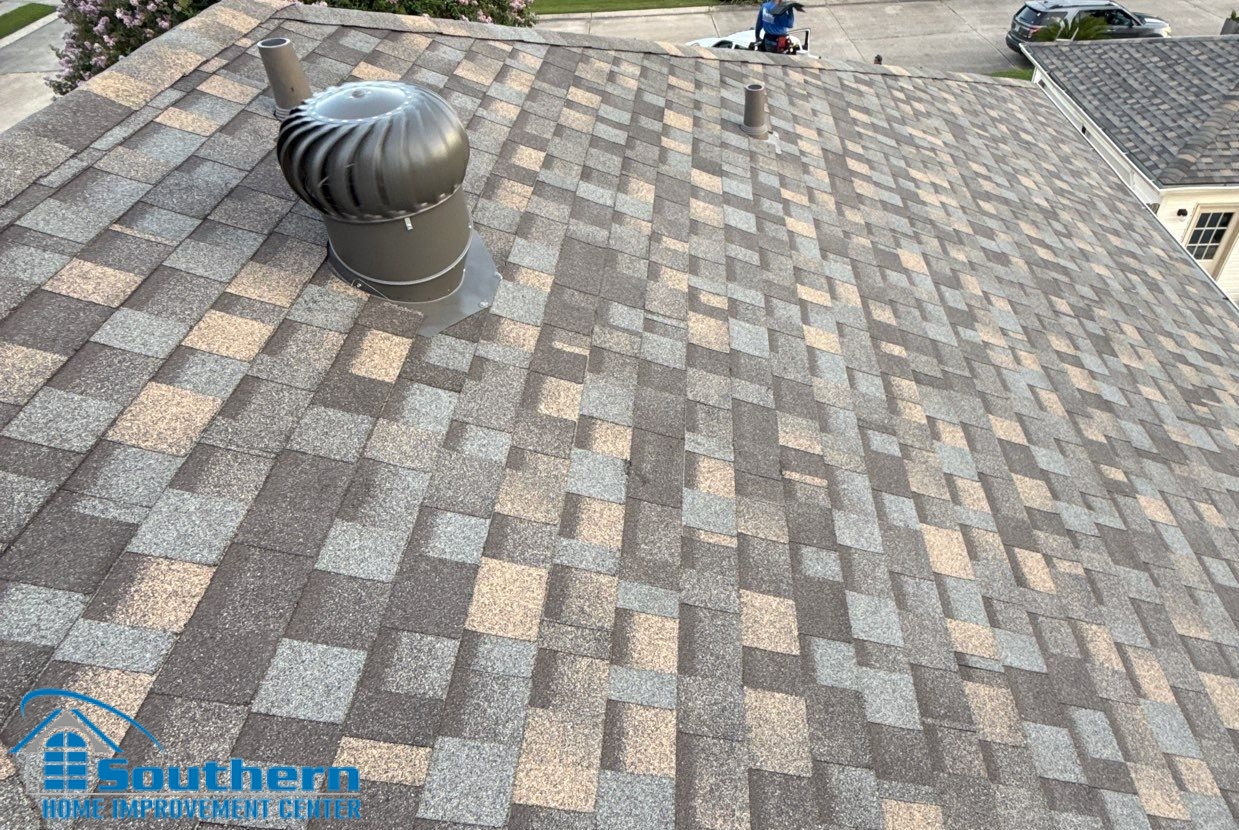
A turbine is a roof-mounted exhaust vent with a rotating head. Wind can increase airflow through the opening, while the vent still provides a passive opening when the head is not spinning. The quantity and location should be based on the listed capacity of the exact product — not only its outside diameter.
Turbines can be useful when a roof does not have enough continuous ridge for a ridge-vent layout. Each unit creates a roof penetration, so base adjustment, flashing, fastening, alignment, and product documentation matter in Gulf Coast wind and rain.
Turbine vent advantages
- Useful where high ridge length is limited
- Can place exhaust in selected upper attic areas
- Wind can increase movement through the vent
- May be practical for some retrofit layouts
Turbine vent limitations
- Visible above the finished roof
- Bearings and rotation should be checked over time
- Every unit requires a correctly flashed roof opening
- Poor placement can leave disconnected areas with weak airflow
Wind-driven rain changes the decision
Storm performance depends on the exact product and installation
A vent type is not automatically storm-ready because it is described as “baffled,” “high-wind,” or “all-weather.” On homes in Southeast Louisiana and along the Mississippi Gulf Coast, the proposal should identify the exact vent product and the installation details that apply to the roof.
For a ridge vent
- Listed net free ventilating area per linear foot
- Approved roof pitch and deck-slot dimensions
- External baffle and water-management details
- Specified fasteners and ridge-cap installation
- End plugs or end treatment required by the manufacturer
For a turbine vent
- Listed capacity for the exact model and size
- Wind and wind-driven-rain documentation
- Base setting for the actual roof pitch
- Flashing integration with the roof covering
- Attachment, alignment, clearance, and free rotation
The most common hidden problem
More exhaust will not fix blocked soffit intake
Perforated soffit panels do not prove that outside air can enter the attic. The openings behind the finish may be too small, painted over, covered by solid material, blocked by insulation, or disconnected from the rafter bays. Baffles may be needed to keep insulation away from the roof deck and preserve the airflow path.
Before choosing either vent, calculate the required net free ventilating area under the locally adopted code, verify the manufacturer-listed capacity of each product, and confirm that usable intake is not less than the planned exhaust. The separate ventilation guide below explains the sizing process in detail so this comparison can stay focused on product choice.
Detailed sizing resource Roof Ventilation Guide for Gulf Coast Homes Review NFVA, the 1/150 and conditional 1/300 ratios, soffit intake, baffles, powered fans, and common ventilation mistakes. Read the guide →Avoid competing exhaust paths
Can ridge vents and turbine vents be used together?
They should not be casually combined within the same open attic zone. A turbine, ridge vent, gable vent, static vent, or powered fan can become the easiest source of replacement air for another exhaust opening. Instead of drawing outdoor air from the soffits, the system may short-circuit between upper vents.
Mixed vent types can be appropriate only when a roof professional has confirmed separate attic zones or designed a coordinated layout using actual elevations, openings, intake, and product capacities. Adding a turbine to an existing ridge vent because the attic feels hot is not a reliable diagnosis.
A practical selection guide
Which roof vent should you choose?
- The roof has enough continuous high ridge
- Low soffit intake is open and distributed
- You want a low-profile roofline
- The selected product has suitable wind and rain documentation
- The vent can be installed to its exact slot and cap requirements
- A hip or segmented roof has limited usable ridge
- Exhaust must serve specific upper attic areas
- The correct number of units fits without overcrowding the roof
- Each penetration can be properly flashed and attached
- The exact product meets the project’s storm-performance needs
The attic area, roof geometry, intake openings, insulation, baffles, separated zones, moisture sources, and existing exhaust all affect the correct design.
What a useful inspection should document
Before changing the ventilation system
- 01
Map the attic and roof zones
Identify usable ridge, hips, valleys, additions, vaulted areas, changes in elevation, and internal separations.
- 02
Inspect the real intake path
Look behind soffit finishes, check eave openings, and confirm that insulation or debris does not block the path.
- 03
Calculate using listed capacities
Use the applicable code ratio and each product’s listed net free ventilating area rather than gross vent dimensions.
- 04
Identify competing exhaust
Record ridge, turbine, static, gable, powered, kitchen, bath, and dryer openings before changing the layout.
- 05
Check moisture and heat sources
Roof leaks, ceiling air leakage, disconnected ducts, weak insulation, and HVAC problems should not be misdiagnosed as a vent shortage.
- 06
Write the complete scope
Specify the vent product, quantity, location, intake work, baffles, slot or flashing details, fasteners, and roof repairs.
Choose the right next step
Related roofing and ventilation resources
Homeowner questions
Ridge vent and turbine vent FAQ
Is a ridge vent better than a turbine vent?
A ridge vent is often better for a simple roof with adequate continuous ridge and open soffit intake. A turbine may be more practical on a hip or segmented roof with limited usable ridge. The correct choice depends on actual geometry and listed vent capacity.
Do turbine vents work when there is no wind?
The opening can still provide passive exhaust when the turbine head is not spinning, but wind can increase airflow. The system should be sized using the exact product’s listed ventilation data rather than an assumed wind-driven airflow rate.
Does a ridge vent need soffit vents?
A ridge vent needs a dependable source of low intake. In many homes that intake is provided at the soffits. Without a clear intake path, upper exhaust may draw through ceiling leaks or other roof vents instead of moving air from the eaves.
Can I add turbine vents to a roof that already has a ridge vent?
Do not add turbines to the same open attic zone without evaluating the complete system. The vents may compete and draw air through one another. Separate attic zones or a deliberately engineered layout require a project-specific review.
Which vent is better for a hip roof?
Many hip roofs have short ridges, so a conventional ridge vent may not provide enough listed exhaust area. Properly distributed turbines or static point vents may fit better, but the final design still requires adequate low intake and storm-rated installation details.
Will a new roof vent lower my electric bill?
Ventilation can help manage attic heat and moisture, but it does not replace insulation, ceiling air sealing, duct repair, or correct HVAC performance. Energy savings should not be guaranteed from a vent change alone.
Can ridge vents or turbine vents leak during a hurricane?
Any roof opening can admit water if the product is unsuitable, damaged, or installed incorrectly. For Gulf Coast homes, verify the exact vent’s wind and wind-driven-rain documentation and follow its flashing, fastening, slot, and cap requirements.
Roof and attic ventilation review
Not sure which vent fits your roof?
Southern Home Improvement Center can inspect the visible roof and ventilation layout, review soffit intake, identify competing exhaust paths, and prepare a practical scope for homes in Southeast Louisiana and along the Mississippi Gulf Coast.
Request a Free Roof InspectionNew Orleans / Jefferson(504) 833-1835
Slidell / Northshore(985) 643-6611
Baton Rouge(225) 766-4244
Mississippi Gulf Coast(228) 467-7484