
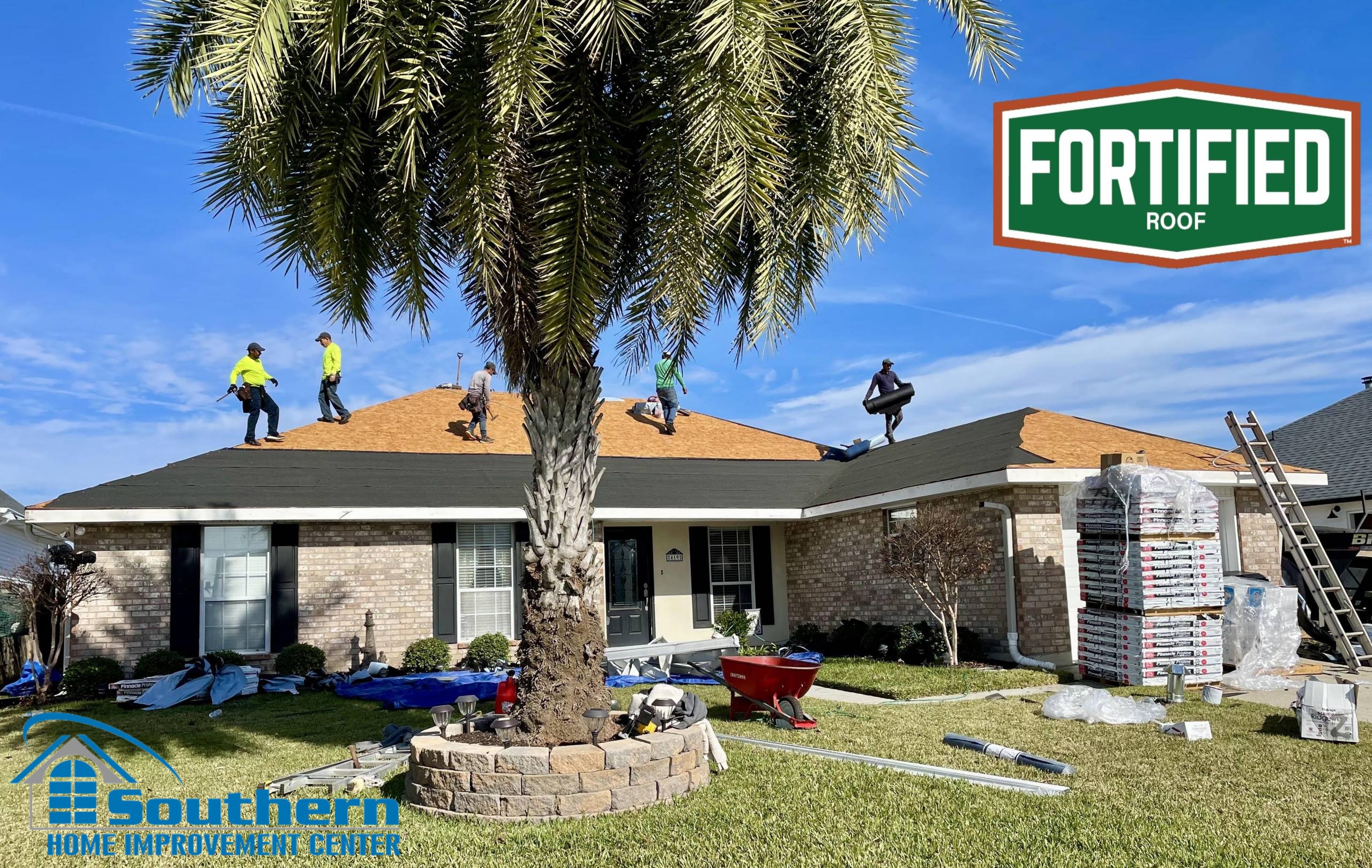
What Is a FORTIFIED Roof and Why Gulf Coast Homeowners Should Care
Gulf Coast Homeowner Guide
A FORTIFIED Roof is more than a new roof covering. It is a complete roof system built to the Insurance Institute for Business & Home Safety (IBHS) FORTIFIED standard, documented during construction, independently evaluated, and reviewed before a designation is issued. For homeowners in Southeast Louisiana and along the Mississippi Gulf Coast, that distinction matters when comparing storm-resilience upgrades, estimates, grants, and insurance questions.
No roof can prevent every loss or guarantee that water will never enter a home. FORTIFIED is designed to reduce common paths of severe-weather damage by strengthening the roof deck connection, creating a sealed roof deck, securing vulnerable edges, and coordinating roof components as one verified assembly.
Direct answer
What Is a FORTIFIED Roof?
A FORTIFIED Roof™ is a roofing system that meets defined construction and documentation requirements developed by IBHS. It is not a shingle brand, a contractor-created label, or a general synonym for a strong roof. The designation applies to a specific property only after the required materials and construction details have been documented by an independent certified FORTIFIED Evaluator and accepted through the program review process.
The assembly beneath the finished roof
What Makes the Roof System FORTIFIED?
The applicable scope depends on the property, roof geometry, construction type, selected roof covering, evaluator findings, location, and current FORTIFIED standard. The following elements explain the basic system approach without substituting for a project-specific evaluation.
Enhanced Roof-Deck Attachment
The connection between the roof deck and framing is reviewed and brought into compliance using the applicable fasteners and attachment pattern. This work must be documented while it can still be seen.
Sealed Roof Deck
An approved sealed-deck method helps limit water passing through sheathing joints if shingles, metal panels, tiles, or another primary roof covering are damaged or displaced.
Stronger Roof Edges
Drip edge, starter material, fastening, overlaps, and perimeter attachment are coordinated to reduce the opportunity for wind to get beneath the roof covering at vulnerable edges.
Rated Roof Covering
The roof covering and its installation must meet applicable wind-testing, design-pressure, attachment, and product requirements. The brand name alone does not establish compliance.
Compatible Vents and Penetrations
Roof-mounted vents, pipe penetrations, flashing, skylights, and equipment require details that address high wind, wind-driven rain, water shedding, and documentation.
Construction Records
Required photographs, product labels, compliance documents, evaluator records, and installation details create proof of work that will be concealed after the roof is complete.

Three progressive levels
FORTIFIED Roof, Silver, and Gold Are Different Scopes
Homeowners sometimes use the word “FORTIFIED” without specifying a level. Every level includes the roof requirements, but Silver and Gold extend the scope to additional parts of the home. The correct level depends on the property, planned work, budget, and evaluation path.
| Designation level | Primary focus | What homeowners should understand |
|---|---|---|
| FORTIFIED Roof | Roof deck attachment, sealed decking, edges, covering, vents, flashing, and required verification. | This is the roof-focused level and is commonly considered when an existing home needs a full roof replacement. |
| FORTIFIED Silver | All Roof requirements plus additional vulnerable parts of the home, such as specified openings, attached structures, or other components required by the standard. | Silver is broader than a roofing contract and may require work by additional trades. |
| FORTIFIED Gold | Roof and Silver requirements plus an engineered continuous load path connecting the roof, walls, and foundation. | Gold treats the home as a connected structural system and generally involves the most extensive evaluation and construction scope. |
Avoid common misunderstandings
What a FORTIFIED Roof Does Not Mean
It is not hurricane-proof
FORTIFIED is intended to reduce damage from specific severe-weather risks. It cannot eliminate every possibility of roof damage, water intrusion, interior loss, or structural failure.
It is not simply an impact-rated shingle
Class 3 or Class 4 impact resistance describes testing of the roof covering. FORTIFIED addresses a larger roof system. An optional Hail Supplement follows additional requirements.
It is not established by the estimate
Words such as “FORTIFIED-ready,” “hurricane-rated,” or “built to FORTIFIED standards” are not the same as a current designation issued after independent verification.
It does not guarantee financial benefits
Grant eligibility, insurance treatment, tax rules, financing, and roof construction are separate matters. Each has its own requirements, timing, documentation, and decision maker.
Compare equal scopes
FORTIFIED Roof vs. Standard Roof Replacement
A code-compliant standard roof replacement can still be a sound project. The difference is that a FORTIFIED path adds a defined resilience standard, independent verification, construction-stage documentation, and a designation review. Homeowners should compare written scopes line by line instead of assuming that every upgraded roof includes the same work.
| Comparison area | Standard replacement | FORTIFIED Roof path |
|---|---|---|
| Construction baseline | Applicable code, manufacturer instructions, and the written contractor scope. | Applicable baseline requirements plus the current FORTIFIED standard. |
| Roof-deck attachment | Handled according to code and project conditions. | Reviewed and documented against defined FORTIFIED attachment requirements. |
| Secondary water control | Underlayment and related details specified in the proposal. | An approved sealed roof-deck method with required installation records. |
| Roof edges and components | Standard project details selected for the roof system. | Specific perimeter, roof-cover, vent, flashing, and attachment requirements with verification. |
| Third-party evaluation | Not normally part of a conventional reroof. | A certified independent evaluator documents applicable requirements. |
| Final result | A completed roof with contractor and manufacturer records. | A designation is issued only after documentation and program review are accepted. |
Plan construction and verification together
How the FORTIFIED Designation Process Works
The FORTIFIED path should be selected before tear-off begins. Many required details become hidden as construction advances, so the roofing company and evaluator must coordinate the scope, materials, site visits, photographs, and records from the start.
- 1
Property and Roof Review
The existing roof, deck condition, geometry, covering, vents, penetrations, attached structures, roof-mounted equipment, and other eligibility considerations are reviewed before the final scope is approved.
- 2
Independent Evaluator Selection
The homeowner selects a certified FORTIFIED Evaluator. The evaluator is a separate third party who documents compliance; the evaluator does not replace the roofing company or perform the roof work.
- 3
Written Scope and Product Planning
The proposal should identify the deck work, sealed-deck method, edge details, roof covering, vents, flashing, evaluator responsibilities, documentation, exclusions, and procedure for concealed damage discovered after tear-off.
- 4
Installation by an Eligible Roofing Company
For projects subject to the 2025 standard, the roof must be installed by a certified FORTIFIED Roofing Company that employs at least one certified FORTIFIED Wise Roofing Contractor. Current provider status should be confirmed before work begins.
- 5
Construction-Stage Documentation
The evaluator and project team collect the required photographs, labels, product information, forms, and other records while critical deck, sealed-roof, perimeter, and roof-covering details remain visible.
- 6
Submission, Review, and Designation
The evaluator reviews the file for completeness and submits it through the FORTIFIED process. A designation certificate is issued to the property after the documentation is reviewed and accepted.
- 7
Records and Future Renewal
The homeowner keeps the designation certificate, contract, invoices, product records, proof of payment, photographs, and evaluator documents. A renewal inspection is required at the end of the five-year designation period.
The entire roof assembly matters
Can Asphalt Shingles, Metal, or Tile Be Used?
FORTIFIED is not limited to one roof-covering material or manufacturer. Asphalt shingles, metal roofing, tile, and other eligible systems may be used when the products, testing, design pressures, attachment, flashing, accessories, and installation details meet the applicable standard for the project.
A premium shingle does not automatically make a roof FORTIFIED, and a FORTIFIED designation does not automatically mean the roof covering has an impact rating. The roof covering is only one part of the documented assembly. Product selection must be completed before installation so the roofing company and evaluator can confirm the applicable requirements and evidence.
Review before ordering
- Roof-cover manufacturer, product line, and required wind rating
- Deck attachment and sealed-deck method
- Underlayment, starter, drip edge, and perimeter fastening
- Valleys, wall flashing, chimney details, and pipe penetrations
Coordinate before tear-off
- Vents, skylights, turbines, and roof-mounted equipment
- Low-slope transitions and mixed roof-covering areas
- Required evaluator observations and photographs
- Product substitutions if planned materials become unavailable
Separate construction from financial programs
FORTIFIED Roof Costs, Grants, and Insurance
The price of a FORTIFIED roof is property-specific. Roof size, pitch, height, access, geometry, deck condition, existing layers, selected covering, sealed-deck method, edge details, flashing, ventilation, evaluator fees, permits, and concealed repairs can all affect the written estimate.
A grant, insurance discount, tax provision, or financing option is not part of the construction standard itself. A homeowner may pursue a qualifying FORTIFIED Roof without a grant, while a grant participant must follow the separate program rules before work starts.
Louisiana
The Louisiana Fortify Homes Program may provide grants of up to $10,000 when a funded round is open and the homeowner, property, providers, timing, and completed work meet program requirements. Registration periods open and close. Grant approval should be confirmed before construction begins.
Louisiana Regulation 136 establishes benchmark FORTIFIED discounts that apply to the hurricane portion of the premium, with insurer implementation directed no later than January 1, 2027. That is not the same as a guaranteed reduction on the full policy bill.
Mississippi
Strengthen Mississippi Homes has a separate eligibility, application, approval, provider, construction, and documentation process. Program status and available funding should be confirmed before a homeowner commits to a grant-dependent schedule.
Insurance treatment depends on the insurer, policy, property, designation, and current rating rules. Homeowners should request a policy-specific explanation in writing before relying on projected savings.
Questions before signing
What Should a FORTIFIED Roof Estimate Explain?
A useful estimate should describe the roof assembly and responsibilities clearly enough for a homeowner to compare equal scopes. A shingle brand, total price, or promise that the roof will be “FORTIFIED-ready” is not enough.
Which designation level and current standard apply to the project?
Who is the independent evaluator, and who pays the evaluator fee?
Is the roofing company currently eligible for projects under the applicable FORTIFIED standard?
Which deck attachment, sealed-deck, edge, covering, vent, and flashing methods are included?
How will damaged decking and other concealed conditions be priced and approved?
Who collects product records, photographs, compliance forms, and close-out documents?
Which items are required for FORTIFIED and which are optional material or warranty upgrades?
What permits, exclusions, cleanup, warranties, and final homeowner records are included?
Louisiana and Mississippi Gulf Coast planning
Choose the Correct Local Installation Page
This guide explains what FORTIFIED means. The state service pages address local commercial questions such as property eligibility, roof replacement planning, evaluator coordination, wind-design considerations, estimates, and service areas.
Homeowner questions
Frequently Asked Questions About FORTIFIED Roofs
Is a FORTIFIED Roof the same as a hurricane roof?
“Hurricane roof” is an informal marketing phrase and does not identify a single verified standard. A FORTIFIED Roof follows defined IBHS requirements and a third-party documentation process. It is designed to reduce specific severe-weather vulnerabilities, but it is not hurricane-proof.
Can a completed conventional roof be certified afterward?
Do not assume so. Important deck attachment, sealed-deck, edge, and component details must be documented at the correct construction stages. Start with a certified evaluator and a compliant written scope before tear-off or installation.
Who issues the FORTIFIED designation?
The roofing company performs the construction. An independent certified FORTIFIED Evaluator documents applicable requirements and submits the file. A designation is issued to the property after the documentation is reviewed and accepted through the FORTIFIED process.
How long does a FORTIFIED designation last?
A FORTIFIED designation is issued for a five-year period. A certified evaluator must inspect the property for renewal. The renewal process confirms that the roof covering remains in acceptable condition and that changes to the home have not affected compliance.
Does every home qualify?
No. Eligibility and scope can depend on the structure, foundation, roof geometry, deck condition, covering, additions, attached structures, roof-mounted equipment, and other property conditions. The evaluator and roofing company should review the home before the path is finalized.
Do I need a grant to install a FORTIFIED Roof?
No. An eligible homeowner can choose to fund a qualifying FORTIFIED project independently. Louisiana Fortify Homes and Strengthen Mississippi Homes are separate grant paths with their own eligibility, selection, approval, provider, timing, and documentation rules.
Will a FORTIFIED Roof lower my insurance premium?
A current designation may support an available discount or credit, but the result depends on the state, insurer, policy, property, designation level, premium structure, and required documents. Ask the insurer for a policy-specific calculation before relying on projected savings.
Can an existing roof qualify without a full tear-off?
Some eligible existing roofs may support an approved attic-side sealed-deck retrofit path, but this is not a shortcut around the full evaluation and designation requirements. Roof condition, remaining service life, property eligibility, installation method, documentation, and program review still matter.
Can storm-damaged roofing be replaced through the FORTIFIED process?
Potentially, if the property is eligible and the replacement is planned around the current FORTIFIED standard before concealed work begins. Insurance coverage, grant eligibility, construction scope, and FORTIFIED designation are separate determinations.
Plan before tear-off
Compare a Standard Reroof With a FORTIFIED Roof Path
Southern Home Improvement Center can review the roof, prepare a written replacement estimate, and coordinate the construction scope with the documentation process. Contact the office serving your area before materials are ordered or concealed roof work begins.
Request a Roof Estimate