
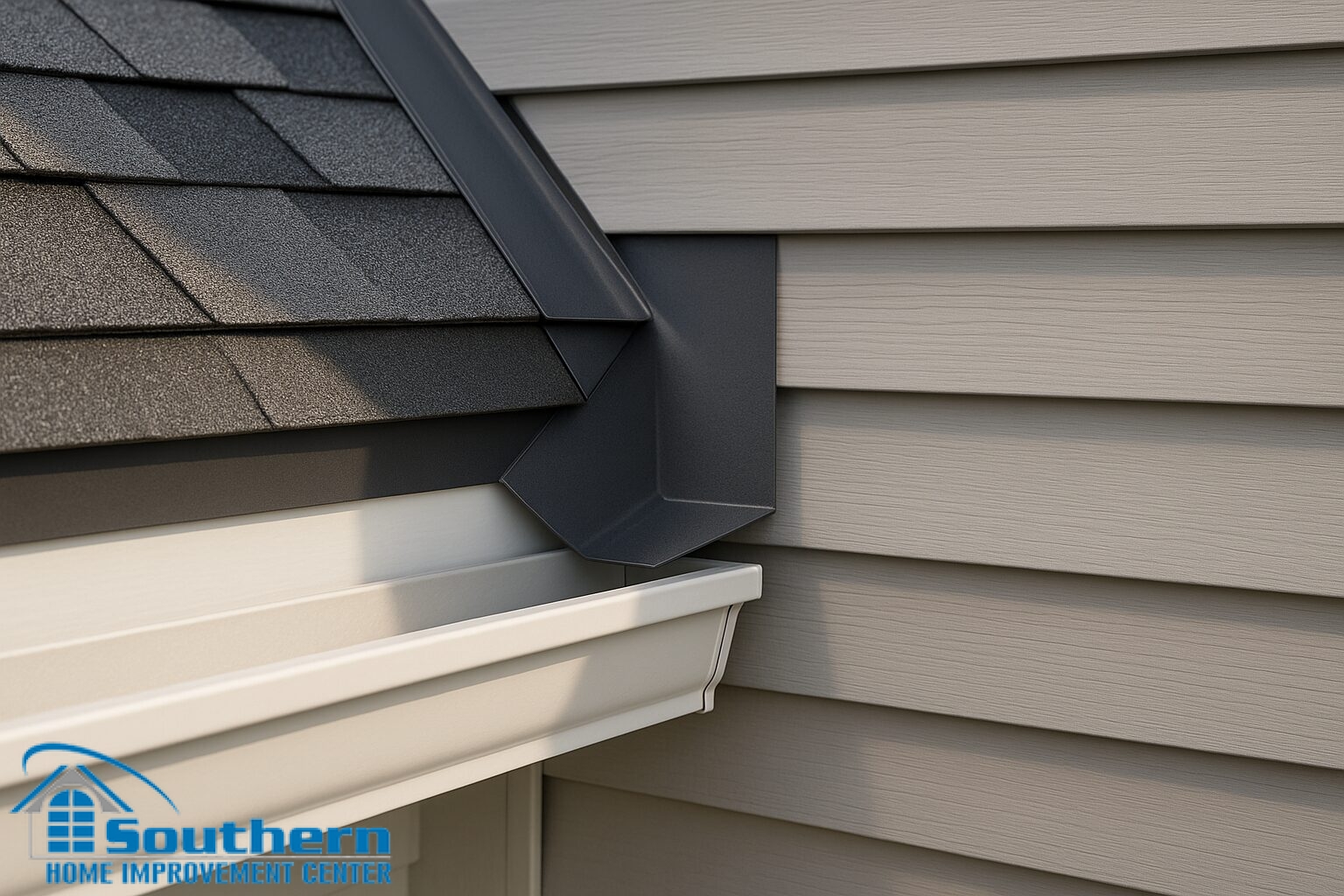
Roof Flashing for Gulf Coast Homes: Types, Leak Signs, and Repair
Shingles cover most of a steep-slope roof, but many roof leaks begin where that broad surface is interrupted. Chimneys, sidewalls, valleys, plumbing vents, skylights, and roof edges all need carefully integrated flashing to keep rain moving toward the gutters instead of behind the roof covering. For homeowners in Southeast Louisiana and along the Mississippi Gulf Coast, those details matter even more when heavy rain arrives with wind.
What is roof flashing? Roof flashing is a water-shedding component, commonly made of corrosion-resistant metal or formed flashing material, installed at roof edges, intersections, and penetrations. Its job is to bridge vulnerable transitions and direct water back onto the roof surface or into the drainage system. A bead of caulk alone is not a substitute for correctly layered flashing.

The basic principle
What Roof Flashing Does That Shingles Cannot
Asphalt shingles are designed to overlap across a broad roof plane. They are not shaped to seal every corner, wall, pipe, or change in direction. Flashing fills that gap by creating a durable drainage path at the places where roofing materials meet another surface.
Correct flashing does not try to make the roof behave like a sealed bathtub. Instead, it follows the same shingle-style principle of layering: higher pieces overlap lower pieces so gravity carries water downslope. The underlayment, flashing, shingles, siding or masonry details, and gutters must all connect in the right sequence.
Flashing manages transitions
Every opening or intersection changes the way water moves. The flashing shape must match that location, whether it is a stepped wall connection, a chimney, an open valley, a plumbing vent, or a roof edge.
Sealant supports the detail
Compatible sealants may be part of a complete installation, but exposed sealant ages and can separate. The lasting defense comes from correctly formed, overlapped, fastened, and integrated materials.
Know the component
Common Types of Roof Flashing and Where They Belong
“Flashing” is not one universal strip of metal. A home may use several specialized details, each designed for a different path of water. When evaluating a leak or comparing a roofing proposal, ask which component is being repaired rather than accepting the vague phrase “seal flashing.”
| Flashing type | Typical location | What it controls |
|---|---|---|
| Step flashing | Where a sloped roof runs beside a wall, dormer, or chimney side | Individual overlapping pieces work with each shingle course to move water down the intersection. |
| Kick-out flashing | At the bottom of a roof-to-wall intersection | Turns concentrated runoff away from siding, stucco, or brick and toward the gutter. |
| Headwall or apron flashing | Where the upper end of a roof slope meets a vertical wall | Directs water from the wall transition back onto the roof covering. |
| Base and counterflashing | Around chimneys and some masonry transitions | Creates a layered two-part assembly that can accommodate movement while keeping water out. |
| Valley flashing | Where two roof slopes meet in an inside angle | Handles concentrated runoff moving through one of the busiest drainage paths on the roof. |
| Pipe boot flashing | Around plumbing stacks and similar round penetrations | Seals the opening while its flange remains integrated with the shingles and underlayment. |
| Skylight flashing | Around the skylight curb or frame | Uses a coordinated head, sill, and side detail, often based on the skylight manufacturer’s system. |
| Drip edge | At eaves and rakes | Guides water away from the roof edge and helps protect the deck edge and fascia. |
A chimney cricket is part of the water-management plan
A cricket is a small peaked structure installed upslope of a chimney to divide runoff and send it around the masonry. It does not replace chimney flashing; it changes the water path so the flashing is not forced to manage concentrated water and debris buildup by itself.

Find the cause
Why Roof Flashing Fails on Gulf Coast Homes
Flashing problems are often described as if the metal simply “wore out.” Sometimes corrosion or age is the issue, but many failures begin with how the assembly was designed, integrated, altered, or repaired. Gulf Coast heat, humidity, heavy rainfall, and wind-driven rain expose those weaknesses quickly.
Incorrect layering
If an upper component sends water behind a lower one, the assembly works against gravity. A flashing piece can look present from the ground and still be lapped incorrectly beneath the shingles or wall finish.
Missing kick-out detail
Without a diverter at the bottom of a sidewall, runoff can travel behind siding, wash against stucco, or soak a wall near the gutter end. The damage may appear below the roofline rather than in the attic.
Old caulk-only repairs
Repeated smears of roof cement or sealant can hide a failed joint temporarily without rebuilding the drainage path. Expansion, movement, UV exposure, and standing water can reopen the same leak.
Fastening and movement
Roofs, walls, chimneys, and metal components expand and move differently. Poor fastening or fastening that locks materials together incorrectly can deform flashing or pull it away from a surface.
Corrosion or incompatibility
Coastal air, trapped moisture, dissimilar materials, and unsuitable fasteners can shorten the service life of a flashing detail. Replacement materials should be selected as a compatible system.
Work added after the roof
Solar attachments, satellite mounts, vents, additions, and wall repairs can interrupt an existing drainage plane. Every later penetration or tie-in needs its own properly integrated flashing plan.
Read the pattern
Signs a Roof Leak May Be Coming From Flashing
The visible ceiling stain is not always directly below the opening. Water can move along roof decking, rafters, fasteners, insulation, and wall cavities before it appears indoors. The location and timing of the moisture still provide useful clues.
Inside the home or attic
- Staining near a chimney breast, exterior wall, dormer, or skylight
- Damp decking or insulation beside a plumbing vent or roof transition
- Peeling paint, swollen trim, or musty odors near the top of an exterior wall
- A leak that appears only during wind-driven rain from a certain direction
- Recurring moisture after the same area was previously “sealed”
Visible from the ground
- Loose, bent, lifted, or visibly separated metal
- Rust staining or heavy sealant buildup around a chimney or wall
- Missing kick-out flashing where a roof edge meets a wall and gutter
- Water streaks, discoloration, or damaged cladding below a roof-to-wall joint
- Debris holding moisture in a valley or behind a chimney
A flashing leak may be intermittent. Calm vertical rain can move down the roof normally, while strong wind pushes water sideways or uphill into a weak lap. That is why “it only leaks during the worst storms” is still meaningful diagnostic information.
Stay off a wet roof
How Homeowners Can Check for Flashing Problems Safely
Do not climb onto a wet, steep, storm-damaged, or unfamiliar roof. A useful first review can be completed from the ground and from accessible indoor areas.
Document the weather
Record when the leak appears, wind direction if known, rain intensity, and how long moisture continues after the rain stops.
Map the interior symptom
Photograph the stain or drip, note the nearest exterior wall, chimney, vent, skylight, valley, or roof change, and mark whether the area grows.
Look from a safe vantage point
Use binoculars or a camera zoom from the ground. Check visible metal edges, wall intersections, chimney areas, roof valleys, and staining below gutter ends.
Check accessible attic areas
Only when it is safe, look for damp wood, dark trails, wet fasteners, or compressed insulation. Avoid exposed wiring and unstable or unboarded attic areas.
Preserve the evidence
Keep dated photos and note earlier repairs. Do not cover the exterior with new sealant before the source has been evaluated and documented.

Correct the water path
What a Proper Roof Flashing Repair Should Address
A lasting repair begins with diagnosis, not a tube of sealant. The contractor needs to determine which transition is admitting water, how the pieces are layered, whether nearby roofing materials remain serviceable, and whether moisture has affected the deck or wall below.
1. Trace and expose the source
The visible symptom is compared with the roof geometry and rain pattern. Enough surrounding material is opened to see the actual lap, fasteners, substrate, and damage.
2. Inspect connected materials
Shingles, underlayment, deck edges, wall sheathing, masonry joints, siding, and nearby gutters are reviewed as relevant to the location.
3. Rebuild the layered detail
Damaged or unsuitable flashing is replaced or corrected so upper components overlap lower components and water exits onto the roof or into the gutter.
4. Use compatible materials
Flashing, fasteners, boots, membranes, and sealants should be appropriate for the roof covering, adjacent surfaces, local exposure, and manufacturer instructions.
5. Restore the surrounding roof
Removed shingles or other roof materials are replaced with a dependable tie-in. Brittle or badly worn materials may make a narrow patch less reliable.
6. Verify drainage and document
The finished area should shed water without trapping debris or sending runoff behind a wall. Final photos help document what was corrected.
Why repeated surface sealing is a warning sign
Sealant can be appropriate at specific joints, but it should not be asked to replace missing step flashing, create a kick-out, correct a buried valley, rebuild chimney counterflashing, or integrate a pipe boot with the shingles. If the same location has been coated several times and still leaks, the assembly may need to be opened and rebuilt.
Choose the right scope
Can Flashing Be Repaired Without Replacing the Roof?
Often, yes. A defined flashing failure can be repaired when the surrounding roof covering is still flexible, secure, compatible, and suitable for a reliable tie-in. The answer changes when the flashing problem is only one symptom of broader deterioration.
A targeted repair may make sense when
- The leak source is limited to one chimney side, pipe boot, short wall section, or similar component.
- Nearby shingles can be lifted or replaced without widespread breakage.
- The deck and wall materials around the leak remain sound.
- The roof does not have a pattern of leaks across several slopes or transitions.
- The correction can be integrated with the existing underlayment and roof covering.
A broader roofing scope may be stronger when
- Several flashing locations have failed or were installed incorrectly.
- Shingles are brittle, curling, losing substantial granules, or difficult to match and tie into.
- Moisture damage extends into decking, wall sheathing, framing, or multiple interior areas.
- Past patching has not stopped recurring leaks.
- An upcoming roof replacement would allow all transitions to be rebuilt as one coordinated system.
Compare scopes, not vague promises
What a Roof Flashing Estimate Should Explain
The cost of flashing work depends on access, roof pitch, the type and length of the detail, how much roofing must be removed, material compatibility, and whether hidden wood damage is found. A useful written proposal should define the work clearly enough for the homeowner to understand what is being rebuilt.
For a roof replacement proposal, flashing should not disappear into the word “accessories.” Chimneys, walls, valleys, skylights, penetrations, and edge metal can involve different materials and labor. Ask for those locations to be identified before comparing estimates.
Gulf Coast resilience
Roof Flashing, Wind-Driven Rain, and FORTIFIED Roofing
Wind-driven rain tests roof intersections from angles that calm rainfall may not. It can expose weak laps at walls, valleys, edges, vents, and other interruptions even when the open field of shingles still looks intact. Stronger roof planning therefore considers more than the shingle product.
FORTIFIED roofing guidance includes flashing at roof penetrations, roof-to-wall intersections, valleys, gables, and eaves as part of a coordinated roof system. A FORTIFIED designation involves specific requirements, documentation, and verification; replacing one flashing component alone does not make an existing roof FORTIFIED. However, the same principle is useful for any Gulf Coast home: edges, penetrations, water-shedding layers, deck condition, fastening, and flashing details should be evaluated together.
Homeowner questions
Roof Flashing FAQ
What is the most common sign of damaged roof flashing?
Recurring moisture near a chimney, wall, skylight, valley, or roof penetration is a common clue. Outside, look for separated metal, rust staining, missing kick-out flashing, heavy layers of old sealant, or water damage below a roof-to-wall transition.
Can I repair roof flashing with caulk?
Caulk or compatible roofing sealant may be used at specific joints within a properly designed assembly, but it cannot replace missing or incorrectly layered flashing. A surface patch may temporarily hide the symptom while water continues behind the roof or wall materials.
Does all roof flashing need to be replaced during a roof replacement?
That decision depends on the flashing type, its condition, material compatibility, how it is integrated, local requirements, and the roof manufacturer’s instructions. The proposal should state clearly which flashing will be replaced and whether any existing components will remain.
Why does my roof leak only during heavy wind-driven rain?
Wind can push rain into a weak lap or transition that sheds calm rainfall normally. Sidewalls, chimneys, valleys, vents, and roof edges are common areas to investigate, but a professional inspection is needed to identify the actual entry point.
What is the difference between step flashing and kick-out flashing?
Step flashing consists of overlapping pieces installed along a sloped roof-to-wall intersection. Kick-out flashing is the diverter at the bottom of that run; it sends water away from the wall and toward the gutter instead of letting runoff continue behind the exterior finish.
Is a pipe boot considered roof flashing?
Yes. A pipe boot is a preformed flashing component used around a plumbing vent or similar round penetration. Its base must be integrated with the roofing layers, and its collar must remain sealed around the pipe.
Can chimney flashing be repaired without removing shingles?
Some limited counterflashing work may not require removal of every surrounding shingle, but base or step flashing repairs usually require access to the layered assembly. The correct scope depends on which component failed and whether nearby materials can be reused safely.
Should I climb onto the roof to inspect flashing?
No. Wet, steep, aged, or storm-damaged roofs can be dangerous, and walking can damage shingles. Start with ground-level photographs, indoor documentation, and accessible attic observations, then use a qualified contractor for the roof-level evaluation.
Continue with the right next step
Related Roof Repair and Water-Management Guides
Request a professional evaluation
Concerned About a Flashing Leak?
Southern Home Improvement Center can inspect the roof transition, trace the likely water path, document visible conditions, and explain whether a targeted repair or broader roofing scope makes sense for your home.
Request a Free Estimate