Louisiana & Mississippi Gulf Coast Window Replacement
Casement & Awning Window Replacement in Louisiana & Mississippi
Casement and awning windows are useful replacement options for Gulf Coast homeowners who want controlled ventilation, easy operation, and a compression-style closing system. Both styles open outward, but they work differently and fit different rooms, wall layouts, and everyday needs.
Southern Home Improvement Center installs complete replacement window units across Southeast Louisiana, Baton Rouge, Greater New Orleans, the Northshore, and the Mississippi Gulf Coast. The right scope depends on the existing opening, window dimensions, wall construction, glass package, exposure, drainage details, and whether standard or impact-resistant options are being considered.
A casement or awning design does not automatically make a window hurricane-rated, impact-resistant, leak-proof, or appropriate for every opening. Compare the exact product specifications, glazing package, ratings, installation requirements, and documentation for the unit being quoted.
Opens outward from the side and is typically operated with a crank or similar hardware.
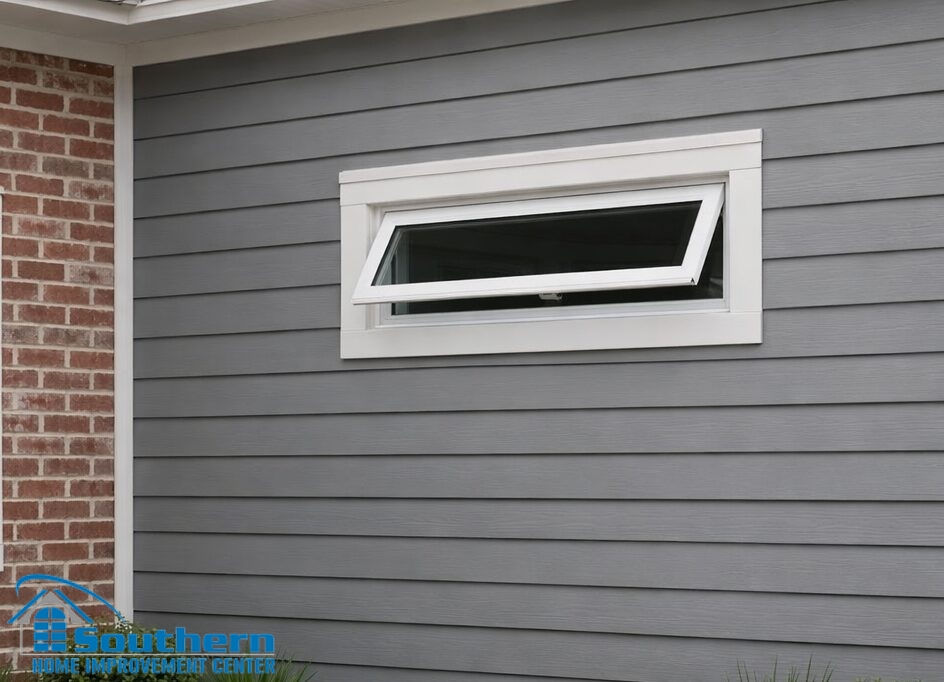
Opens outward from the bottom while remaining hinged along the top edge.
Flashing, sill details, perimeter integration, fit, and finishing remain critical regardless of style.
Low-E, laminated, impact-resistant, privacy, and other options depend on the selected window line.
Start with how the window will be used
Casement vs. Awning Windows: What's the Difference?
Both are projecting windows: the sash opens outward rather than sliding inside the frame. Their hinge location changes how they operate and where they tend to fit best.
Side-Hinged Operation
A casement sash is hinged along one side and swings outward. When the sash closes, it presses against the frame and weather seals.
- Useful where a larger vertical opening fits the elevation
- Good option when controlled ventilation is important
- Compression-style closing can provide low air leakage with the right product and seals
- Requires clear exterior swing space
- Hardware and opening direction should be considered before ordering
Top-Hinged Operation
An awning sash is hinged across the top and projects outward from the bottom. This creates a different opening pattern while retaining compression-style closure.
- Useful for shorter or wider openings
- Can provide controlled ventilation in bathrooms, kitchens, and other rooms
- May allow ventilation during some light-rain conditions
- Can work above or below compatible fixed windows in selected configurations
- Requires exterior clearance for the projecting sash
The final decision should also account for opening dimensions, egress requirements where applicable, exterior obstacles, screens, hardware access, ventilation needs, view, appearance, product ratings, and the surrounding wall.
Side-hinged replacement windows
Where Casement Windows Work Well
Casement windows can be a practical choice where homeowners want an operable window with a relatively unobstructed glass area and a sash that closes against the frame.
Casements can provide a clean vertical window profile with ventilation when the exterior has room for the sash to open.
Selected casement configurations may work in bedrooms, but the exact opening must be checked against applicable size, operation, and egress requirements.
Crank-style operation can be useful in selected locations where reaching and lifting a traditional sash would be less convenient.
Casements can be combined with fixed or other compatible window styles when the elevation calls for different functions by opening.
When a Casement May Not Be the Best Choice
An outward-opening sash needs clearance. Walkways, narrow side yards, landscaping, screens, exterior fixtures, patios, or other obstacles may make a slider, hung window, or another configuration more practical.
Top-hinged replacement windows
Where Awning Windows Work Well
Awning windows are useful when the opening benefits from ventilation but a traditional tall operable sash is not the best fit.
Awning configurations can combine ventilation with privacy-glass options depending on the selected product line.
A shorter projecting window can be useful in selected kitchen layouts where ventilation and accessible operation matter.
Awning windows can fit shorter horizontal openings where a full-height operating sash would not suit the wall design.
Selected systems allow awning units to be combined with compatible fixed glass to balance ventilation with a larger view area.
The top-hinged sash can provide some shelter during light rain, but wind-driven rain and severe weather are different conditions. Operable windows should be used according to manufacturer instructions and closed when weather conditions require it.
One reason homeowners compare these styles
Why Casement & Awning Windows Can Have Lower Air Leakage
Unlike sliding or hung windows, which move along tracks, casement and awning sashes close by pressing against the frame and weather seals.
This operating geometry can help reduce air leakage, but actual performance still depends on the individual window, quality and condition of its seals, manufacturing tolerances, installation, adjustment, and hardware.
For storm performance, compare the actual product ratings, glazing, anchorage requirements, opening size, impact documentation when applicable, and installation instructions rather than assuming one operating style is automatically stronger.
Compare the label, not just the window style
Window Ratings to Review Before Choosing a Package
Two casement windows can look similar and still have different performance characteristics. The same is true for awning windows.
For Louisiana and Mississippi homes, the best package is not automatically the window with the longest feature list. Solar exposure, room use, orientation, storm goals, existing wall conditions, budget, and the complete installation scope should all be considered.
Choose glass and style together
Glass Options for Casement & Awning Windows
The operating style determines how the sash works. The glazing package affects other parts of the window's performance and daily use.
Low-emissivity coatings can help manage heat transfer and solar gain depending on the specific coating and complete window package.
Modern replacement units commonly use insulating glass assemblies designed as part of the complete manufactured window.
Selected patterns or obscure-glass options may be useful for bathrooms and other openings where privacy matters.
Selected product lines may offer laminated or impact-resistant configurations for homeowners comparing stronger storm-focused packages.
The opening matters as much as the unit
What Professional Casement & Awning Window Installation Should Address
Installing a replacement window is not only a matter of placing a new frame into an opening and applying sealant around the perimeter.
Windows interrupt the exterior wall's water-management system. The installation therefore needs to account for the opening, flashing strategy, drainage plane, sill, sides, head, surrounding cladding or trim, anchorage, interior finishing, and the manufacturer's instructions for the selected unit.
Measured Opening
The replacement unit must fit the actual opening and allow the required installation clearances.
Sill Water Management
The bottom of the opening should be detailed so incidental water can be directed outward rather than into the wall cavity.
Side & Head Integration
Flashing and surrounding materials should be integrated in the correct sequence with the wall's drainage system.
Square & Stable Installation
Proper positioning and anchorage help an operable sash close, lock, and contact its seals as intended.
Perimeter Air Sealing
The rough-opening perimeter should be addressed as part of the complete installation rather than relying only on visible exterior caulk.
Interior & Exterior Finish
The quote should make clear how trim, returns, siding interfaces, sealant, and other finish work will be handled.
Flashing and drainage details need to work with the surrounding wall assembly so water is directed toward the exterior rather than trapped around the opening.
Compare proposals carefully
What Should Be Included in a Window Replacement Quote?
Comparing only the price per window can hide meaningful differences in product specification and installation scope.
Storm-focused window options
Can Casement & Awning Windows Be Impact-Resistant?
Impact-resistant configurations may be available in casement and awning styles depending on the manufacturer, product line, dimensions, glazing, hardware, and required performance characteristics.
Do not assume that laminated glass alone makes a complete window assembly impact-rated. When impact resistance matters, verify the exact tested assembly and the documentation associated with the product being quoted.
The safest comparison is based on the manufacturer, series, configuration, opening size, glazing, applicable ratings, installation requirements, and supporting documentation rather than a general label such as “storm window” or “hurricane window.”
Diagnose the problem before selecting the scope
When Full Window Replacement Makes Sense
Not every draft, condensation mark, or moisture symptom automatically means a window needs to be replaced. On the other hand, recurring problems involving the complete frame or opening may make full replacement more practical than repeated temporary corrections.
Sashes that no longer open, close, lock, or remain aligned properly may justify replacement depending on the condition of the unit.
Significant frame damage, deterioration, distortion, or surrounding moisture damage can expand the required scope.
Repeated leakage should be diagnosed to determine whether the problem originates at the window, installation, flashing, wall, or another exterior component.
When several older windows have operation, comfort, seal, or condition problems, phased or broader replacement may make more sense.
If you are seeing fogging, condensation, staining, or water around an opening, the first step is to identify the symptom and determine whether complete window replacement is appropriate.
Other operating styles
Casement, Awning or Sliding Windows?
No single operating style needs to be used throughout an entire house. Many replacement projects make more sense when the window type changes according to room function and opening geometry.
| Window Style | Operation | Useful When | Check Before Ordering |
|---|---|---|---|
| Casement | Side-hinged, opens outward | Controlled ventilation and compression-style closure are priorities | Exterior swing clearance, handing, size, hardware and ratings |
| Awning | Top-hinged, opens outward | Shorter openings or controlled ventilation fit the room | Exterior clearance, opening height, hardware and ratings |
| Sliding | Sash moves horizontally | A wider opening or non-projecting operation is preferred | Track operation, drainage, meeting rails and glass package |
| Hung | Sash moves vertically | A traditional appearance and familiar operation suit the elevation | Opening size, sash configuration, ventilation and cleaning access |
| Fixed | Does not open | View and daylight matter more than ventilation | Glass package, size, solar exposure and emergency-egress needs nearby |
Louisiana & Mississippi service area
Casement & Awning Window Replacement Across the Gulf Coast
Southern Home Improvement Center installs complete replacement window packages in its Louisiana service areas and on the Mississippi Gulf Coast, subject to project location, product availability, scope, and scheduling.
Slidell, Lacombe, Mandeville, Covington, Madisonville, and nearby Northshore communities.
New Orleans, Metairie, Kenner, Jefferson, Harahan, River Ridge, and nearby Southshore communities.
Baton Rouge, Prairieville, Gonzales, Denham Springs, Central, and nearby communities.
Window replacement scheduling for selected coastal Mississippi communities and project scopes.
Continue your window research
Related Window Replacement Guides
Common homeowner questions
Casement & Awning Window Replacement FAQ
Which seals better: casement or sliding windows?
Casement windows generally have lower air-leakage potential than sliding styles because the sash closes by pressing against the frame. Actual performance still depends on the specific product, seals, adjustment, ratings, and installation.
Are casement windows automatically better for hurricanes?
No. Operating style alone does not establish hurricane or impact performance. Compare the exact product ratings, glazing, anchorage, dimensions, applicable impact documentation, and installation requirements.
Can an awning window stay open when it rains?
The top-hinged configuration can provide some protection during light rain, depending on wind direction and conditions. It should not be interpreted as permission to leave the window open during severe weather or wind-driven rain.
Can casement and awning windows use Low-E glass?
Low-E and other glazing packages are available in many replacement-window lines. Availability and performance values depend on the manufacturer, series, configuration, and selected glass package.
Can casement or awning windows be impact-resistant?
Yes, impact-resistant configurations may be available in selected product lines. The complete tested window assembly and its supporting documentation should be verified rather than assuming that the operating style or laminated glass alone establishes impact resistance.
Should I use casement windows throughout the entire house?
Not necessarily. A mixed package may work better. Casements, awnings, sliders, hung windows, and fixed units can be selected according to opening size, room function, ventilation, exterior clearance, appearance, and performance goals.
Does SHIC replace only the glass in a fogged window?
No. Southern Home Improvement Center focuses on complete replacement-window projects rather than glass-only or insulated-glass-unit replacement. A fogged, leaking, or deteriorated window should be evaluated to determine whether complete replacement is the appropriate scope.
What should I compare between casement and awning window estimates?
Compare the exact manufacturer and series, operating configuration, dimensions, glass package, applicable performance ratings, screens and hardware, removal scope, flashing and water-management details, finishing work, treatment of hidden damage, warranties, and total written project scope.
Replacement Windows · Louisiana & Mississippi Gulf Coast
Compare Casement & Awning Windows for Your Home
Southern Home Improvement Center can measure your existing openings, compare appropriate replacement-window styles and glass packages, and provide a written installation scope based on the home and project.