
A Compact Ivory Screen Room and Flat-Pan Patio Cover for a Baton Rouge Patio
Some outdoor projects make their point through scale. They spread wide, add dramatic coverage, and announce themselves from across the yard. This Baton Rouge project works in the opposite way. Its strength is not size. Its strength is control.
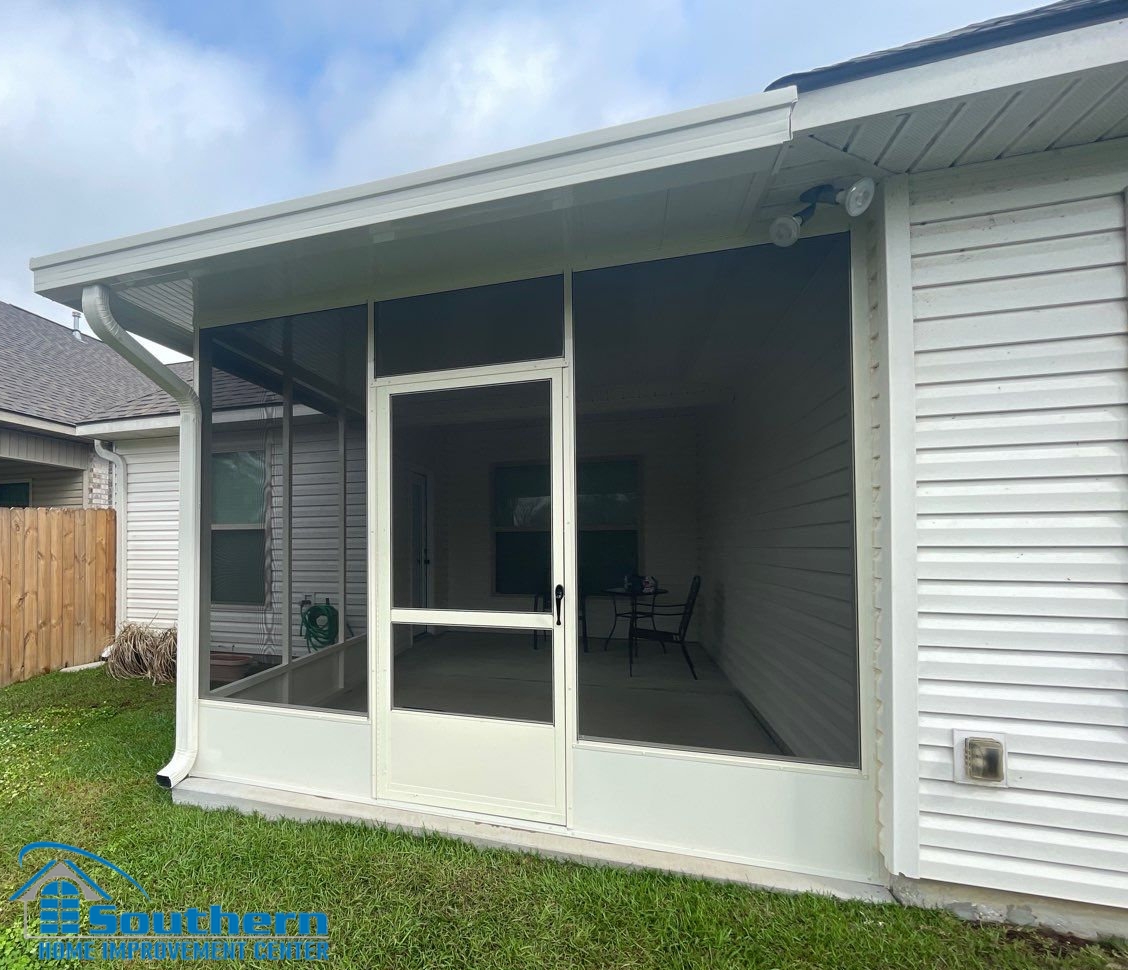
Southern Home Improvement Center (SHIC) completed a compact two-part installation that paired a custom Southern Sun Room Bahama Breeze screen room in Ivory with a Southern Shademaker heavy-duty structural flat-pan aluminum patio cover. The screen room measures approximately 10 ft. x 11 ft. The patio cover above it measures approximately 10 ft. x 10 ft. The enclosure includes an aluminum kickplate and one door. The roof system includes valances and a full gutter system and was built without fan beams.
That list of details explains the build, but it does not yet explain why this project deserves its own page. The answer is simple: on a patio this size, every decision becomes more visible. A compact footprint leaves less room to hide bad proportion, unnecessary bulk, or mismatched components. This installation succeeds because the enclosure, the roofline, the finish, and the layout were handled with discipline from the beginning.

The Patio Did Not Need to Become Larger. It Needed to Become Clearer.
A great deal of home improvement marketing assumes the same story fits every property: add more span, add more square footage, add a bigger statement. In reality, many patios do not suffer from a lack of scale. They suffer from a lack of definition.
That was the more interesting challenge here. This Baton Rouge patio did not call for an oversized structure. It called for a cleaner sense of edge, a more settled top line, and a stronger feeling that the area had a purpose beyond simply being an open slab beside the house. The solution was not expansion for its own sake. The solution was measured enclosure.
Once the screen room and patio cover were installed, the space read differently. It no longer looked like an in-between zone that happened to have some coverage. It began to read as a real outdoor room — still open to the yard, still light in feel, but no longer visually unresolved.

Project Specifications
On a larger build, specifications like these can disappear into the overall impression of the structure. On a compact patio, they are the structure. The measurements determine whether the build feels composed or awkward. The roof detail determines whether the upper half feels finished or abrupt. Even the number of doors changes how the enclosure is perceived.

Small Footprints Change the Rules
One reason compact patio projects are worth studying is that they play by a different set of visual rules than bigger installations. Large structures can tolerate more complexity. They have the physical room to absorb extra lines, deeper roof expressions, multiple entries, or stronger contrast in finish. Small patios are less forgiving.
That is why this project is more useful than another oversized showpiece for many homeowners searching for a screen room in Baton Rouge or a patio cover in Baton Rouge. A compact build like this answers a more practical question: what does a patio improvement look like when the goal is not to make the backyard feel crowded?
In that sense, this installation is about proportion more than spectacle. The enclosure is large enough to define use, but not so large that it overwhelms the slab. The roof is strong enough to complete the structure, but not so assertive that it dominates the entire composition. The footprint remains modest, yet the patio feels noticeably more intentional.

The Screen Room Functions as a Boundary, Not as Bulk
The Bahama Breeze screen room in this project does something that many people overlook when they first think about patio enclosures. It does not just add screening. It introduces a boundary condition. It gives the patio a readable perimeter.
That change matters because outdoor spaces often feel incomplete when they have no clear edge. Even when there is a slab and some degree of overhead protection, the area may still feel like residual space. Enclosure changes that. It defines where the patio begins as a room-like environment and where it releases back into the rest of the yard.
On this Baton Rouge project, the 10 ft. x 11 ft. enclosure is large enough to create that effect without making the patio feel boxed in. That balance is important. A small patio enclosure should not feel apologetic, but it also should not feel heavy-handed. Here, the screen room provides just enough structure to change the experience of the space while still preserving openness.
Why the One-Door Layout Matters More Than It Sounds
One door is easy to list and easy to ignore. It should not be ignored on a project like this.
Every opening changes the rhythm of a compact enclosure. Each door interrupts the frame line, creates a point of emphasis, and changes how the eye reads the perimeter. On a larger screen room, multiple entries may feel natural. On a smaller screen room, they can make the structure appear fragmented.
The one-door configuration here keeps the shape calmer. It makes circulation direct. It avoids turning the enclosure into a collection of pieces. That is the kind of decision that rarely gets highlighted in generic SEO copy, yet it strongly affects the finished look of the project.

The Roof Above the Enclosure Is Part of the Main Idea
Too many project descriptions treat the roof as a supporting accessory, as though the primary story is always the enclosure below. That approach would miss the point here. The flat-pan aluminum patio cover is not an add-on detail. It is central to why this build looks resolved.
The 10 ft. x 10 ft. Southern Shademaker cover sets the upper boundary of the patio in a way that feels measured and stable. The flat-pan design creates a straighter, more controlled profile than a looser overhead treatment would. The valances help finish the edge. The full gutter system gives runoff a proper path and supports a neater overall presentation during and after rain.
There is also an aesthetic reason the roof matters so much on this project. Without the cover, the enclosure could have looked isolated. With the cover, the patio gains a more complete silhouette. The top and sides now belong to the same architectural thought.
For readers studying roof-first examples, SHIC also has a dedicated Baton Rouge flat-pan patio cover project and a separate custom aluminum patio cover page. Those pages are useful comparisons, but they tell a different story from this tightly matched enclosure-and-cover build.

The Ivory Finish Does Real Work Here
Color is not a cosmetic afterthought on a compact build. Finish changes perceived mass. A darker enclosure would have made this structure feel denser and more forward in the yard. Ivory keeps the frame visually lighter and allows the patio to retain an airy character after enclosure.
That is especially helpful on smaller patios where there may not be a deep buffer of yard around the structure. The screen room still reads clearly, but it does not bear down on the space. The result is cleaner, brighter, and easier to integrate with the home’s exterior.
Ivory also supports the overall logic of the project. This build was not meant to become a dominant visual object. It was meant to organize and finish the patio. The lighter finish helps it do exactly that.
Why “No Fan Beam” Was the Right Choice
Because fan beams are frequently mentioned as a desirable patio cover feature, it is easy to assume that not including them means the project gave something up. In this case, that would be the wrong conclusion.
On a compact roofline, restraint can be more valuable than additional emphasis. The absence of fan beams helps the cover stay cleaner and less visually busy. It keeps the roof from becoming heavier than the enclosure below it. It also supports the central logic of the project: solve the patio carefully, not loudly.
That is what makes this a good reference for homeowners considering a small aluminum patio cover in Baton Rouge. More components do not always create a better result. Sometimes they simply make a compact build look overworked.
Why This Project Is More Useful Than a Bigger One for Many Readers
Large projects are easy to admire. Smaller ones are often more instructive. A larger structure can hide mediocre proportion behind sheer presence. A compact structure cannot. Its decisions are exposed. If the layout is clumsy, the project feels clumsy. If the roof is too assertive, the patio feels burdened. If the finish is too dark, the enclosure feels heavier than it should.
That is why this page has value beyond one property. It shows what careful sizing looks like in practice. It shows how a screened patio in Baton Rouge can become more usable and more finished without pretending to be a much larger outdoor room. It also shows that a smaller footprint does not mean a lesser project. In some ways, it demands more precision.
One of the quiet problems in home improvement content is that it often describes every project as though bigger automatically means better. Real properties are more complicated than that. Many homes do not need a broad new span or a dramatic backyard statement piece. They need an outdoor area that looks settled, drains correctly, and fits the house without visual strain.
This Baton Rouge installation is a better model for that kind of decision-making. The patio now has enclosure, coverage, and a more disciplined identity, but it still feels like it belongs to the scale of the home. The improvement is obvious. The footprint remains controlled. The patio feels more complete because the design stopped where it should stop.
Related Projects
Homeowners comparing layout types, roof conditions, and finish combinations usually benefit from seeing a few nearby examples. These four projects are useful comparison points for different screen room and patio cover approaches.


Get a Free Estimate for a Screen Room or Patio Cover in Baton Rouge
If you are planning a screen room, a screened patio, or a compact aluminum patio cover in Baton Rouge, Southern Home Improvement Center (SHIC) can help you evaluate footprint, roof style, drainage details, finish options, and overall layout before construction begins. Call the office that fits your area below, or fill out the form on the page to request a free estimate.