
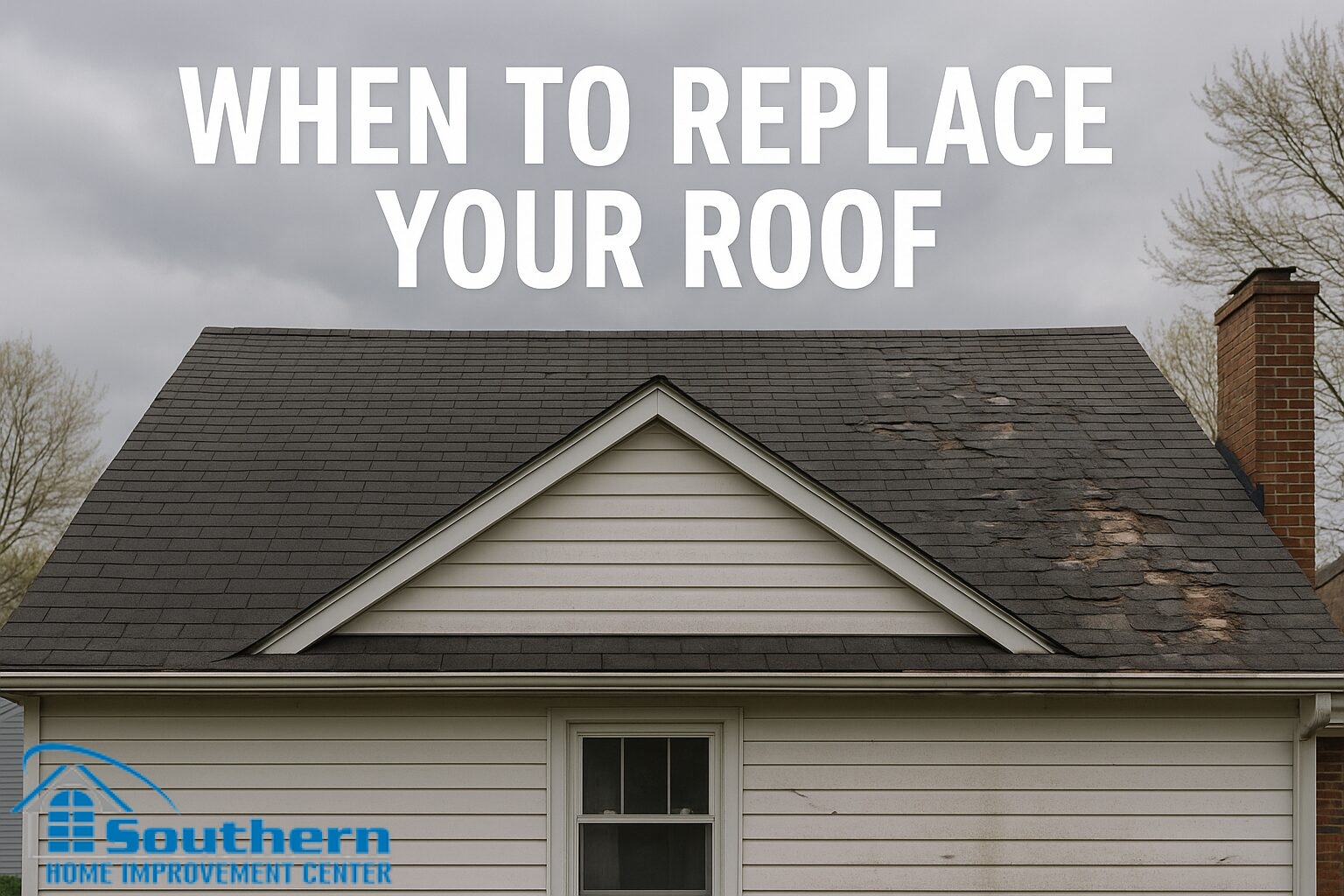
When to Replace Your Roof in Southeast Louisiana & Mississippi
A 15-, 20-, or even older roof should be evaluated based on its actual condition, repair history, decking, leaks, materials, storm exposure, and remaining repairability. One damaged shingle or one leak also does not automatically justify a full replacement.
Insurance coverage, FORTIFIED designation, grants, tax credits, financing, and other financial programs are separate from the construction decision. Southern Home Improvement Center can evaluate roof conditions and provide a written scope, but insurers and program administrators make their own coverage and eligibility decisions.
A roof does not need replacement simply because it reaches a certain age. The right time to replace a roof usually becomes clearer when several conditions appear together: widespread material wear, recurring leaks, weakened decking, repeated storm damage, failing roof transitions, or repairs that no longer provide dependable value.
For homeowners in Southeast Louisiana and along the Mississippi Gulf Coast, local exposure matters. Heat, humidity, heavy rain, wind-driven water, tropical weather, vegetation, and coastal conditions can affect roof components differently from one property to another. The goal is to identify when another targeted repair is still practical and when a planned replacement becomes the better long-term construction decision.
When Should You Replace a Gulf Coast Roof?
Recurring leaks, widespread shingle deterioration, deteriorated decking, sagging, or damage across several areas can justify replacement planning.
Schedule a documented inspection and compare complete replacement scopes before another storm or an urgent repair forces a rushed decision.
A localized flashing failure, limited shingle damage, or one contained leak may still be repairable when the remaining system is serviceable.
Planning by condition
Roof Age Is a Planning Trigger, Not a Verdict
Roof age matters because materials generally become more difficult to repair as they weather, lose flexibility, experience repeated thermal cycling, and accumulate storm exposure. But age should trigger closer evaluation rather than automatically determine the outcome.
Two asphalt shingle roofs installed in the same year can age differently because of orientation, attic conditions, tree cover, ventilation, installation quality, storm history, roof geometry, drainage, maintenance, and the specific roofing product.
Investigate the Specific Failure
A leak or damaged shingles on a relatively new roof may point to storm damage, flashing, penetrations, installation details, or another localized issue rather than normal end-of-life wear.
Watch for Patterns
Review repair history, granule loss, exposed roof areas, attic moisture, storm damage, and whether the same valley, edge, flashing, or transition repeatedly causes problems.
Begin Replacement Planning
If several aging indicators appear together, obtain a documented condition assessment and compare the expected value of another repair with replacement.
Evaluate Before Another Major Repair
An older roof may still be serviceable, but widespread deterioration, brittle materials, recurring leaks, or deck concerns can make additional patching less practical.
A useful recommendation should explain current material condition, number and location of failures, deck and attic observations, repairability, prior repairs, and why the proposed scope is appropriate.
Look for patterns
Eight Signs a Roof May Need Replacement
The strongest case for replacement normally comes from multiple related conditions rather than one cosmetic issue.
Recurring or Multiple Leaks
Leaks that return after repairs or appear in different parts of the home may indicate more widespread problems with roofing materials, transitions, underlayment, or decking.
Widespread Shingle Wear
Large areas of cracking, curling, missing tabs, exposed matting, damaged seal lines, or brittle shingles indicate broader deterioration rather than one isolated repair area.
Heavy or Uneven Granule Loss
Broad bald areas, visible exposed matting, and recurring heavy granule accumulation may indicate advanced surface wear when they appear with other aging conditions.
Soft, Deteriorated, or Sagging Areas
Soft decking, visible deflection, sagging, or movement may indicate moisture deterioration or a structural concern that requires prompt professional evaluation.
Damage Across Multiple Slopes
Wind, debris, hail, or material deterioration affecting several sections of the roof may require broader evaluation than one clearly contained damaged area.
Repeated Edge and Flashing Failures
Persistent trouble at eaves, rakes, valleys, chimneys, roof-to-wall intersections, vents, or pipe penetrations can indicate that several vulnerable details need to be rebuilt together.
Attic Moisture or Deck Staining
Damp insulation, staining, musty odors, moisture deterioration, or recurring condensation should be investigated to identify water entry, air leakage, ventilation, or other contributing conditions.
A Growing Repair History
If repairs continue accumulating while new failures develop elsewhere, replacement may eventually provide better value than repeatedly addressing isolated symptoms.
Construction decision
Roof Repair or Replacement: A Practical Decision Matrix
A good repair should correct a defined failure and leave a dependable surrounding roof. Replacement becomes more practical when the problem is widespread, materials cannot be reliably integrated with repairs, or several major roof-system details need correction.
Localized Damage, Serviceable Roof
- Damage is limited to one clearly identifiable area.
- Surrounding shingles remain serviceable and can be worked without excessive breakage.
- Decking around the repair area appears sound.
- The leak source is a repairable flashing, boot, vent, valley, or transition.
- Compatible replacement materials are available.
- There is no broader pattern of recurring failures.
Widespread Wear or System Failure
- Leaks or material failures affect several parts of the roof.
- Shingles are broadly brittle, worn, cracked, or difficult to repair.
- Deck deterioration is found in multiple locations.
- Edges, valleys, flashings, vents, or penetrations need broad correction.
- Prior repairs have not stopped recurring problems.
- The expected life of another repair does not justify its cost.
The written estimate should explain which situation applies and why.
Timing
How Quickly Should You Act?
Not every roof problem has the same urgency. Separate immediate safety or active water-entry conditions from replacement projects that can be planned carefully.
- Active interior water entry
- Fallen tree or open roof section
- Visible sagging or suspected structural damage
- Electrical equipment or wiring affected by water
Prioritize personal safety and arrange appropriate temporary stabilization when conditions allow.
- New ceiling stains after a storm
- Missing or visibly displaced roofing materials
- Repeated leaks near valleys, walls, vents, or chimneys
- New roof debris or large amounts of granules around the property
A documented inspection can help determine whether a targeted repair is appropriate or broader planning should begin.
- The roof is aging but not actively leaking
- Repairs are becoming more frequent
- You need roof-condition documentation for insurance or a future sale
- You want to compare standard and FORTIFIED roofing options
Planning early gives you more time to compare scopes, materials, contractors, financing options, and resilience upgrades without emergency pressure.
Do not climb onto a wet, storm-damaged, steep, or visibly weakened roof. Photograph conditions from the ground and inspect only safely accessible attic areas.
Local conditions
Why Gulf Coast Roofs Need a Property-Specific Evaluation
National lifespan estimates cannot account for the exact exposure of an individual home. Properties in Slidell, Mandeville, Covington, New Orleans, Jefferson Parish, Baton Rouge, Bay St. Louis, Gulfport, Biloxi, and nearby communities experience different combinations of sun, wind, rain, humidity, vegetation, salt exposure, and storm history.
Heat and Sun Exposure
Strong ultraviolet exposure and elevated roof temperatures contribute to material aging, while attic heat and moisture conditions can affect the roof system from below.
Wind-Driven Rain
Water can enter around damaged edges, seal lines, valleys, vents, wall transitions, and flashing even when most of the roof still appears intact from the ground.
Humidity and Attic Moisture
Attic moisture can affect decking, insulation, fasteners, interior finishes, and the diagnosis of a suspected roof leak.
Coastal Exposure
Properties nearer saltwater require attention to corrosion resistance and the condition of exposed metal edges, flashings, fasteners, and roof-mounted components.
Trees and Debris
Branches, pine needles, leaves, and organic debris can retain moisture, obstruct drainage, damage roofing materials, and increase wear around valleys and edges.
Complex Roof Geometry
Valleys, low-slope transitions, additions, chimneys, dormers, walls, and attached structures create additional water-management and flashing details that should be inspected individually.
Before approving work
What a Roof Replacement Inspection Should Document
A useful inspection should provide more than a verbal statement that a roof is “old” or “damaged.” The homeowner should be able to understand what was observed and why repair or replacement is being recommended.
- Missing, cracked, curled, loose, or brittle shingles
- Granule loss, exposed matting, and damaged seal lines
- Wind, hail, debris, and previous repair patterns
- Eaves, rakes, drip edge, valleys, and ridges
- Walls, chimneys, skylights, vents, and pipe penetrations
- Flashing condition and prior sealant-based repairs
- Accessible deck staining, softness, deflection, or deterioration
- Insulation moisture, odors, and ventilation pathways
- Visible evidence of current or previous water entry
- What can reasonably be repaired
- Why replacement is or is not recommended
- Photos, proposed scope, materials, assumptions, and exclusions
Compare complete proposals
What Should Be Included in a Roof Replacement Scope?
When replacement is recommended, compare the entire roof system rather than shingle names alone.
Existing layers, removal method, site protection, disposal, cleanup, and magnet sweeping where appropriate.
How deteriorated decking will be identified, documented, priced, and replaced.
Products and installation methods below the visible roof covering, including sealed-deck options when selected.
Drip edge, starter, valleys, roof-to-wall details, chimneys, penetrations, and transitions.
Existing intake and exhaust conditions, compatibility with the roof design, and any proposed corrections.
Manufacturer, product line, color, applicable ratings, fastening requirements, and warranty terms.
Project photographs, permits where applicable, required inspections, warranties, and final paperwork.
Evaluator involvement, applicable deck attachment, sealed-deck, edge, roof-cover, component, and documentation requirements.
Seasonal planning
Should You Replace the Roof Before Hurricane Season?
There is no single month that guarantees ideal roofing conditions. Gulf Coast roof replacement can be completed at different times of year when contractors have a workable forecast window and an appropriate plan to protect the structure during tear-off and installation.
What matters more is the roof's condition. An active leak, open roof area, structural concern, or rapidly worsening damage should not be left unresolved simply to wait for a preferred season.
Do Not Wait on Active Damage
Water entry, open roof areas, widespread storm damage, or structural concerns warrant prompt evaluation.
Use a Workable Forecast Window
For non-emergency replacement, suitable weather, contractor availability, materials, and an effective dry-in plan matter more than choosing one universal month.
Prepare Before Peak Demand
Early planning gives you more control over product selection, scope review, financing, scheduling, and resilience options.
Optional resilience path
Roof Replacement Is the Right Time to Consider FORTIFIED
A full replacement exposes the roof deck, seams, edges, flashing, and other components that must be documented during a FORTIFIED project. This makes replacement the logical point to decide whether an official FORTIFIED designation is one of the project goals.
FORTIFIED is a voluntary construction and reroofing program developed by the Insurance Institute for Business & Home Safety. It is more than an upgraded shingle. The process addresses applicable deck attachment, sealed roof deck, roof edges, coverings, components, and independent evaluation.
A properly scoped standard replacement can correct worn roofing materials, deteriorated decking, flashing, ventilation, edges, and other roof-system details.
The project follows the applicable FORTIFIED standard, includes required construction details, and is documented by a certified independent Evaluator.
A FORTIFIED designation is a construction and verification standard. Financial programs in Louisiana and Mississippi have separate rules, eligibility requirements, application windows, and administrators. Insurance treatment also depends on the applicable state rules, insurer, policy, and designation.
IBHS states that projects permitted on or after November 1, 2025 must comply with the 2025 FORTIFIED Home Standard. Where roof permits are not required, roofs installed on or after November 1, 2025 must meet the 2025 requirements.
Official IBHS 2025 FORTIFIED Home Standard & technical documents →Insurance and technical information
Official Resources for Homeowners
Continue your research
Related Roofing Resources
Homeowner questions
Frequently Asked Questions
How do I know whether my roof needs replacement instead of repair?
Replacement becomes more likely when damage or deterioration affects multiple areas, leaks keep returning, materials are broadly worn or brittle, decking is deteriorated, or several major roof-system details need correction. A localized failure on an otherwise serviceable roof may still be repairable.
Does a 20-year-old roof automatically need replacement?
No. Age is a planning factor, not an automatic verdict. Current roof condition, material performance, repair history, storm exposure, deck and attic findings, and repairability matter more than the calendar alone.
Can one roof leak be repaired without replacing the whole roof?
Often, yes. A single leak may originate from a repairable pipe boot, flashing detail, vent, valley section, or damaged shingle area. Replacement becomes more likely when that leak is one symptom of wider material or roof-system deterioration.
Is granule loss always a reason to replace the roof?
No. Some loose granules can occur during normal weathering. Broad bald areas, exposed matting, heavy recurring accumulation, brittle materials, and other deterioration appearing together justify closer inspection.
Does poor attic ventilation mean the roof must be replaced?
No. Ventilation should be evaluated together with roof design, attic moisture, decking, insulation, intake and exhaust pathways, and roofing condition. Ventilation improvements can often be incorporated into a replacement project when needed.
Will homeowners insurance pay to replace an old roof?
Age alone does not determine whether a claim is covered. Insurance coverage depends on the policy, covered cause of loss, roof condition, deductible, depreciation or settlement provisions, exclusions, endorsements, and insurer findings. Review your actual policy and speak directly with the insurer or licensed insurance professional.
Should I replace my roof before selling my home?
That depends on the roof's condition, buyer and lender requirements, inspection findings, insurance considerations, expected sale economics, and local market conditions. A documented roof assessment can help clarify the available options.
What is the best time of year to replace a Gulf Coast roof?
There is no universal best month. Roof replacement can be completed during suitable weather windows throughout the year. Active damage should not be delayed simply to reach a preferred season.
Can I upgrade to a FORTIFIED Roof during replacement?
Yes, if the property can meet the applicable requirements and the correct FORTIFIED process is followed. A certified Evaluator should be involved before required construction details are concealed so the project can be properly documented.
Does choosing FORTIFIED automatically qualify me for financial assistance?
No. FORTIFIED is a construction and verification program. Grants, state tax credits, insurance discounts, and other incentives have separate rules and should be verified with the responsible agency, insurer, or tax authority before being included in a project budget.
Information notice: Roof conditions and repairability vary by property. Insurance coverage and policy requirements are determined by the insurer, not the roofing contractor. FORTIFIED designation requirements are established by IBHS and may change over time. Financial programs should be verified independently before being included in a roofing decision.
Request a Free Roofing Estimate
Not sure whether your roof needs a targeted repair or complete replacement? Southern Home Improvement Center can evaluate visible roof conditions, discuss conventional and FORTIFIED options, and provide a written project estimate.