
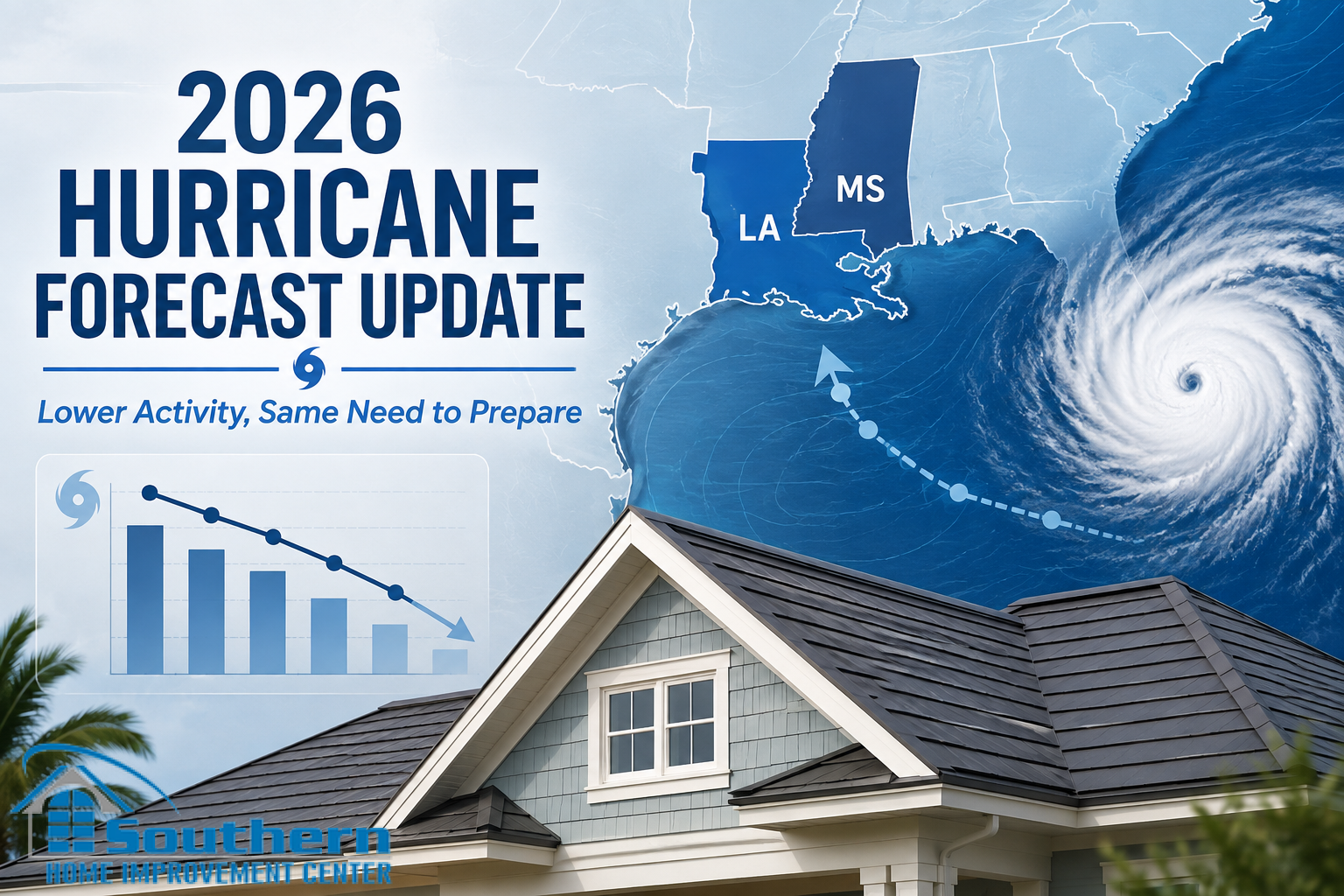
NOAA Lowers 2026 Atlantic Hurricane Forecast: What It Means for Louisiana and Mississippi
NOAA has lowered its forecast for the 2026 Atlantic hurricane season as the Gulf Coast moves closer to the most active part of the season. The August update now gives the Atlantic a 75% chance of a below-normal season, up from 55% in NOAA’s May outlook.
The agency now expects 7–13 named storms, 2–6 hurricanes, and 0–2 major hurricanes for the full season. Those totals include Tropical Storm Arthur and Tropical Storm Bertha, the first two named Atlantic storms of 2026.
For homeowners in Louisiana and along the Mississippi Gulf Coast, the lower forecast is encouraging, but it is not a landfall forecast. Bertha already demonstrated that point when it made landfall in St. Bernard Parish in July as a tropical storm. A quieter Atlantic can still produce heavy rain, wind-driven water, roof damage, gutter overflow, siding damage, and local flooding from a single system.
The 2026 Atlantic Forecast Has Moved Lower
Up from 55% in NOAA’s May outlook.
Including Arthur and Bertha, which have already formed.
Down from the May range of 3–6.
Down from the May range of 1–3.
NOAA’s May Forecast vs. the August Update
NOAA’s preseason outlook, released in May, already favored a below-normal Atlantic hurricane season. The August update increases that confidence and trims several of the expected storm ranges.
| Forecast measure | May 2026 outlook | August 2026 update |
|---|---|---|
| Below-normal season | 55% | 75% |
| Near-normal season | 35% | 20% |
| Above-normal season | 10% | 5% |
| Named storms | 8–14 | 7–13 |
| Hurricanes | 3–6 | 2–6 |
| Major hurricanes | 1–3 | 0–2 |
The update does not mean that 7–13 additional storms are expected from August forward. NOAA’s seasonal ranges cover the full June 1 through November 30 season and already include the two named storms that formed earlier in the year.
The forecast for the number of hurricanes and major hurricanes also shifted lower as atmospheric conditions became less favorable for sustained tropical development.
Why NOAA Lowered the 2026 Hurricane Forecast
The main factor is El Niño. NOAA says El Niño conditions have emerged in the equatorial Pacific and continue to strengthen. El Niño commonly increases vertical wind shear across parts of the tropical Atlantic and Caribbean.
Vertical wind shear is a change in wind speed or direction with height. Strong shear can disrupt the vertical structure of a developing tropical cyclone, making it more difficult for thunderstorms to stay organized around the center and for the system to strengthen.
Strengthening El Niño
El Niño is expected to be a dominant influence during the remaining months of the Atlantic season.
Higher Vertical Wind Shear
Stronger shear can interfere with tropical cyclone organization and intensification across the Atlantic basin.
Less Support for High Activity
Near-average tropical Atlantic temperatures and other large-scale conditions provide less support for an unusually active season.
Colorado State University Is Also Forecasting a Quiet Season
Colorado State University’s August seasonal outlook also points to well-below-average Atlantic activity. CSU is forecasting nine named storms, four hurricanes, and one major hurricane for the full 2026 season.
CSU likewise identifies El Niño and the resulting increase in tropical Atlantic wind shear as the primary reason for the reduced outlook. The two forecasts use different methods and ranges, but both point in the same direction: overall basin activity is expected to finish below average.
Two Named Storms Have Formed So Far in 2026
Through August 6, the Atlantic basin has produced two named storms: Arthur and Bertha. Neither became a hurricane.
Tropical Storm Arthur
Arthur developed near the middle Texas coast in June. The storm remained relatively weak but reinforced an important Gulf Coast lesson: rainfall and local impacts do not require hurricane strength.
Tropical Storm Bertha
Bertha made landfall near the Biloxi Wildlife Management Area in St. Bernard Parish on July 22 with estimated sustained winds of 45 mph.
Bertha is especially relevant for Southeast Louisiana homeowners because it reached the coast as a tropical storm, not a hurricane. Storm category alone does not determine whether a home experiences roof leaks, wind-driven rain, gutter overload, loose exterior materials, or water intrusion.
Why a Lower Forecast Does Not Mean Louisiana and Mississippi Are Safe
Seasonal hurricane outlooks describe expected activity across the entire Atlantic basin. They do not predict whether a hurricane will strike Slidell, New Orleans, Baton Rouge, the Northshore, Gulfport, Biloxi, or another Gulf Coast community.
Landfall location depends on shorter-term weather patterns and steering currents that cannot be predicted months in advance. A below-normal season can therefore contain one damaging Gulf Coast storm, while an active season can send most storms away from Louisiana and Mississippi.
How Many Storms May Form?
Seasonal outlooks estimate overall Atlantic activity across a six-month season.
Where Will a Storm Go?
Track, timing, rainfall, wind field, and landfall risk depend on weather patterns much closer to the event.
What Will the Property Experience?
Roof condition, drainage, trees, exterior openings, attached structures, and local rainfall determine how one home responds.
August, September, and October are historically the busiest part of the Atlantic hurricane season, so Gulf Coast homeowners are entering the period when preparation matters most.
What the Updated Forecast Means for Planned Roof Work
A quieter forecast can actually create a useful planning window. Homeowners with an aging roof, recurring leaks, loose flashing, damaged gutters, deteriorated soffit or fascia, or previous storm-related concerns may have more time to inspect the problem and compare solutions before a tropical system creates urgent demand.
That does not mean every roof should be replaced before hurricane season. The goal is to determine the actual condition of the system while there is still time to choose between maintenance, targeted repair, full replacement, or a FORTIFIED Roof project based on documented findings.
Known or Suspected Problems
Recurring ceiling stains, missing shingles, loose edges, damaged flashing, granules, and attic moisture should be evaluated before another major rain event.
Aging Roof Replacement
Use the quieter period to compare materials, deck work, underlayment, ventilation, warranties, financing, and scheduling without storm-driven pressure.
Standard vs. FORTIFIED Roofing
A planned replacement is the right time to compare a standard code-compliant system with a documented FORTIFIED Roof option.
Gulf Coast Home Checklist Before Peak Hurricane Season
Homeowners do not need to climb onto the roof to perform a useful pre-storm review. Many warning signs can be identified safely from the ground or from accessible interior areas.
- Look for missing, lifted, cracked, or visibly displaced shingles.
- Review areas with previous leaks or repairs.
- Check accessible attic spaces for stains, moisture, or damp insulation.
- Arrange a professional inspection when roof damage is suspected.
- Clear accessible gutters and downspout discharge areas.
- Look for sagging runs, overflow stains, loose attachments, or damaged fascia.
- Confirm that water is directed away from doors, walkways, and the foundation.
- Check visible sealant failures and damaged exterior trim.
- Look for loose siding, damaged corners, and gaps around penetrations.
- Review window and door areas that have leaked during previous heavy rain.
- Check for loose panels, damaged gutters, unstable posts, or visible movement.
- Secure furniture, decorations, grills, tools, and other loose outdoor items when a storm threatens.
- Do not attempt structural storm preparation in unsafe weather.
- Take current photos of the roof, gutters, siding, windows, doors, and exterior elevations.
- Keep contractor invoices, warranties, inspection reports, and product information together.
- Review insurance deductibles, contact information, and storm-related policy provisions.
- Use the National Hurricane Center for active tropical weather information.
- Do not use seasonal outlooks as a substitute for watches, warnings, or local emergency instructions.
- Follow parish, county, state, and local emergency guidance when a storm approaches.
Wet roofing, damaged decking, wind, ladders, and loose materials can create serious fall hazards. Visual checks from the ground and professional inspections are safer.
Related 2026 Hurricane and Roofing Resources
Official Forecast Sources
Frequently Asked Questions
What is NOAA’s updated 2026 Atlantic hurricane forecast?
NOAA now expects 7–13 named storms, 2–6 hurricanes, and 0–2 major hurricanes for the full 2026 Atlantic season. The agency gives the season a 75% chance of finishing below normal.
How is the August forecast different from NOAA’s May outlook?
In May, NOAA forecast 8–14 named storms, 3–6 hurricanes, and 1–3 major hurricanes with a 55% chance of a below-normal season. The August update lowers the storm ranges and raises the below-normal probability to 75%.
Why did NOAA lower the forecast?
Strengthening El Niño conditions are expected to increase vertical wind shear across parts of the tropical Atlantic and Caribbean, making tropical cyclone development and intensification more difficult.
How many named Atlantic storms have formed in 2026?
Two named storms had formed through August 6: Tropical Storm Arthur and Tropical Storm Bertha. Neither reached hurricane strength.
Did Tropical Storm Bertha make landfall in Louisiana?
Yes. Bertha made landfall near the Biloxi Wildlife Management Area in St. Bernard Parish on July 22 with estimated sustained winds of 45 mph.
Does a below-normal forecast mean Louisiana is unlikely to be hit?
No. NOAA’s seasonal outlook predicts overall Atlantic activity, not individual storm tracks or landfall locations. A below-normal season can still produce a damaging storm in Louisiana or Mississippi.
Should homeowners delay roof work because the forecast is lower?
Known leaks, missing shingles, damaged flashing, deteriorated roof edges, drainage problems, or aging roofing should be evaluated based on the condition of the home rather than the seasonal storm count. A quieter period can provide more time to inspect and plan repairs or replacement before emergency demand increases.
Where should homeowners get current storm information?
Use the National Hurricane Center, National Weather Service, and local emergency management agencies for current tropical forecasts, watches, warnings, and safety instructions.
Check Exterior Problems Before the Next Storm
If your roof is aging, leaking, missing shingles, or showing signs of previous storm damage, contact Southern Home Improvement Center for an inspection and written estimate before tropical weather creates an urgent repair situation.