
Gulf Coast Roof Guide
Hail Damage Roof Inspection: A Gulf Coast Homeowner’s Guide
Hail marks on asphalt shingles can resemble blisters, ordinary granule loss, foot traffic, or older wear. This guide explains what homeowners in Southeast Louisiana and coastal Mississippi can check safely, what a professional inspection should document, and how to make the next decision without assuming every dark spot came from the latest storm.
Start with the right question
A Hail Inspection Should Separate Evidence From Assumptions
After a strong thunderstorm, it is reasonable to wonder whether the roof was hit. The useful question is not simply, “Do I see a dark spot?” It is, “What observable pattern is present, which components are affected, and does the evidence support a recent impact event rather than aging or another roof condition?”
That distinction matters on Gulf Coast homes. Hail may arrive with high wind and wind-driven rain, while intense sun, heat, humidity, tree debris, previous repairs, and normal weathering may already have left unrelated marks on the roof. A responsible inspection considers the whole roof system and the property’s condition instead of labeling every blemish as storm damage.
If the storm has just passed, begin with the safe action sequence in SHIC’s after-hail homeowner checklist. The guide below focuses on the next question: how potential hail damage is evaluated.
Visual clues
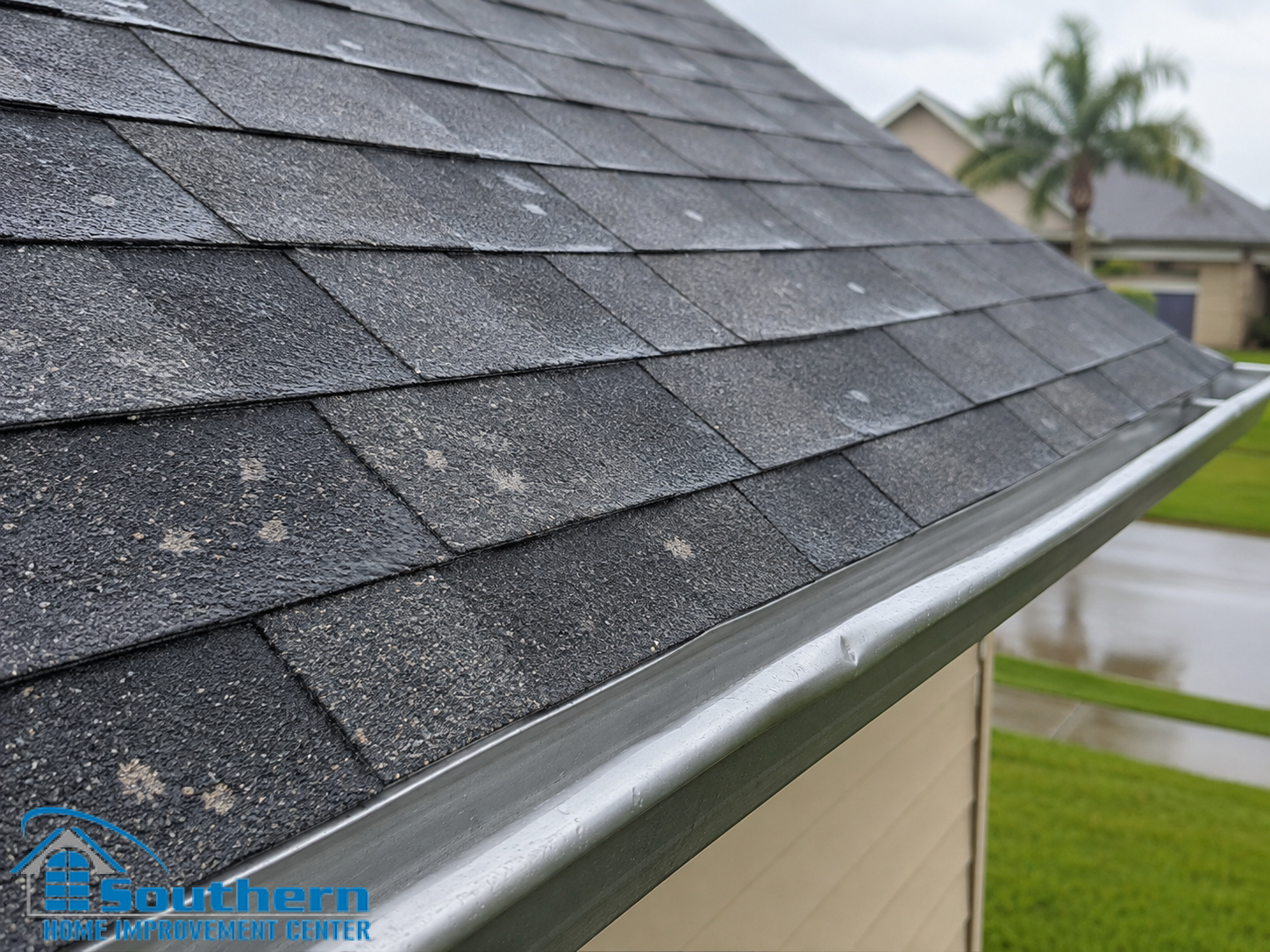
What Hail Damage Can Look Like on Asphalt Shingles
Asphalt shingles do not all respond to impact in the same way. Shingle construction, age, support from the deck, roof slope, hail size and hardness, wind speed, and impact angle can change the visible result. For that reason, there is no single photograph or minimum hail size that proves whether a specific roof was damaged.
Scattered impact marks
Potential hail hits often appear in a random distribution across an exposed roof area. A repeating line, access path, or uniform manufacturing pattern may point to a different cause.
Localized granule displacement
An impact may loosen or remove granules in a small area, leaving a darker or differently textured spot. Color alone is not enough; the shape, freshness, surrounding surface, and broader pattern matter.
Changes in the asphalt or mat
A close inspection may find a depression, exposed asphalt, visible matting, or a fracture beneath the surface. These findings require careful evaluation because pressing, probing, or walking can create additional damage.
Related marks on other components
Dents or fresh marks on vents, flashing, gutters, downspouts, screens, siding, or other exposed materials can help establish a property-wide impact pattern. Collateral marks support context but do not automatically prove functional shingle damage.
New roofs can shed loose granules, and older shingles lose granules through weathering. Use the separate guide to understand when roof granules in gutters may be normal or concerning.
Common look-alikes
Hail Damage vs. Roof Blisters, Wear, and Foot Traffic
No single characteristic should be used in isolation. The comparison below helps homeowners understand why a close, pattern-based evaluation is more reliable than diagnosing a roof from one dark spot or one phone photo.
| Condition | Typical pattern or context | What helps distinguish it |
|---|---|---|
| Possible hail impact | Scattered marks with no simple repeating layout; exposure may differ by roof slope. | Recent storm history, impact distribution, surface or mat changes, and related marks on other exposed components. |
| Shingle blistering | Raised areas or open pits created when a blister forms and the surface later breaks or wears away. | The edges, surface aging, location within the shingle, and similar marks beyond the storm-facing area can point away from a fresh impact event. |
| Normal weathering | Broader, gradual granule loss; fading; cracking; or wear that corresponds with roof age and long-term exposure. | Condition tends to be diffuse rather than limited to fresh, randomly distributed impact points. |
| Foot traffic or mechanical damage | Scuffs, crushed granules, tears, or tool marks near access routes, service areas, valleys, or equipment. | Marks may follow a path or concentrate where someone walked, worked, dragged a hose, or placed equipment. |
| Wind damage | Lifted, creased, displaced, or missing shingles, often near edges, ridges, corners, or vulnerable seal lines. | The failure relates more to uplift and movement than to small impact points, although wind and hail can occur in the same storm. |
| Algae or staining | Dark streaks or shaded-area discoloration that follows moisture and biological growth patterns. | The surface color changes without the impact depression, fracture, or fresh localized granule displacement expected from hail. |
Bottom line: a blister can resemble an impact mark after its surface opens, and an impact can be subtle. The roof’s pattern, component-to-component evidence, age, and storm history must be considered together.
Two-stage checklist
What to Check From the Ground and What an Inspector Should Document
Safe homeowner check
Wait until the weather and surrounding property are safe. Then record observable conditions without climbing.
- Write down the storm date and approximate time.
- Photograph hailstones next to a common object only if they remain safely accessible.
- Photograph yard debris, damaged plants, screens, siding, gutters, downspouts, and exterior metal.
- Look for displaced shingles or ridge material from the ground.
- Check ceilings, walls, and safely accessible attic areas for new moisture.
- Note where each photo was taken and whether the condition was present before the storm.
- Save relevant weather alerts, contractor reports, invoices, and prior roof photographs together.
Professional roof evaluation
The exact inspection method depends on pitch, height, weather, surface condition, and safe access.
- Identify the roof covering, estimated age, previous repairs, and general condition.
- Review accessible slopes, hips, ridges, valleys, eaves, rakes, and roof-to-wall transitions.
- Examine representative areas for impact distribution and possible fractures.
- Check vents, pipe flashings, edge metal, gutters, downspouts, and other exposed components.
- Separate hail indicators from blistering, aging, installation issues, wind damage, and mechanical marks.
- Record limitations when an area cannot be safely accessed or observed.
- Connect photographs to specific roof locations and explain the recommended next step.
Do not create or alter the evidence
Do not press or probe marks.
Testing a questionable spot can enlarge it or create a new condition.
Do not power-wash shingles.
High-pressure cleaning can remove granules and damage the roof surface.
Do not approve work from one photo.
A sound recommendation should reflect the roof system, damage extent, surrounding material, and safe observations.
Local context
Why Louisiana and Mississippi Gulf Coast Roofs Need a Broader Review
Hail rarely arrives as an isolated laboratory event. In Slidell, Mandeville, Covington, New Orleans, Metairie, Baton Rouge, Bay St. Louis, Waveland, Gulfport, Biloxi, Ocean Springs, and nearby communities, the same storm may combine impact, uplift, wind-driven rain, falling limbs, and drainage problems.
Wind can change the damage pattern
Hail driven at an angle may affect roof slopes and wall-facing components differently. Wind may also break seal lines, crease shingles, or loosen edges during the same event.
Heat and age can create look-alikes
Sun exposure and normal weathering can leave older shingles with granule loss, cracking, and surface conditions that require separation from fresh storm impact.
Rain determines urgency
A subtle impact mark may not produce immediate dripping, while wind-driven rain can enter at an edge, flashing detail, vent, or previous repair. Interior moisture changes the priority.
A complete review may identify more than one cause. That is normal. The goal is to document each observable condition accurately and build a repair plan around what the home actually needs.
Decision guide
Does Hail Damage Mean the Roof Must Be Replaced?
No. A suspected hail mark does not automatically mean the roof needs replacement, and the absence of a ceiling leak does not automatically mean the roof is undamaged. The next step depends on the extent and location of verified conditions, the surrounding shingle condition, the roof’s repairability, active water entry, and the requirements that apply to the selected repair or replacement scope.
No functional storm damage is identified
Document the roof condition, address unrelated maintenance items on their own merits, and keep the photographs for future comparison.
A limited, repairable area is affected
A repair may be practical when damage is isolated and compatible materials and sound surrounding shingles allow a durable correction.
Damage or deterioration is widespread
Multiple affected slopes, brittle or poorly repairable shingles, deck concerns, repeated leaks, or extensive related damage may justify a replacement comparison.
Keep the contractor and insurer roles clear
A roofing contractor can document visible construction conditions, explain repairability, and prepare a proposed scope. The insurance carrier determines coverage under the policy. Before filing or authorizing work, review your policy, deductibles, reporting requirements, and the documents your carrier requests. Do not rely on a contractor promise that a particular outcome is guaranteed.
Next resources
Use the Right Page for the Next Step
Frequently asked questions
Hail Damage Roof Inspection FAQ
Can hail damage be invisible from the ground?
Yes. Small surface changes, fractures, and slope-specific impact patterns may not be visible from a driveway. Ground-level observations are still useful for documenting related marks on gutters, downspouts, screens, siding, and other exterior components, but they do not replace a safe roof evaluation when there is a reasonable concern.
Does a hail-damaged roof always leak immediately?
No. Some damage does not produce an immediate interior leak. Other storm-related water entry may begin at flashing, edges, vents, or preexisting weak areas rather than at a hail mark. Check interior surfaces after later rain and document any change promptly.
What size hail damages asphalt shingles?
There is no universal size threshold that predicts the result on every roof. Hail hardness, shape, wind speed, angle, roof slope, shingle construction, age, and deck support all influence impact. The condition of the actual roof is more useful than a size estimate alone.
How can an inspector tell hail damage from blistering?
The inspector compares the shape and edges of the mark, surface and mat condition, distribution across the roof, exposure by slope, roof age, storm history, and collateral marks on other components. No single feature should be treated as conclusive by itself.
Do granules in downspouts prove hail damage?
No. Granules can be released after installation and through normal weathering. A sudden increase after a storm deserves context, but the inspection should also consider shingle age, localized bald spots, broader wear, and related property conditions.
How soon should I request a roof inspection after hail?
Request help promptly once the property is safe, especially if there is active leaking, missing material, or visible exterior impact. If there is no emergency, organize the storm date, photographs, roof history, and policy information so the inspection begins with clear facts.
Will homeowners insurance pay for hail damage?
Coverage depends on the policy, cause of loss, roof condition, deductibles, exclusions, reporting requirements, and the carrier’s evaluation. A contractor can document construction conditions and prepare a scope, but cannot guarantee coverage or a claim outcome.
Can impact-rated shingles still be damaged by hail?
Yes. An impact classification describes performance under a defined test; it does not make a shingle hail-proof. If impact resistance is a priority for a future roof, compare the exact product documentation and read SHIC’s guide to Class 3 and Class 4 impact-rated shingles.
Local roof help
Request a Clear, Photo-Backed Roof Evaluation
Southern Home Improvement Center serves homeowners across Southeast Louisiana, the Baton Rouge region, and the Mississippi Gulf Coast. Tell us when the storm occurred, whether water is entering the home, and which exterior changes you noticed.
Request a Free Roof Inspection