
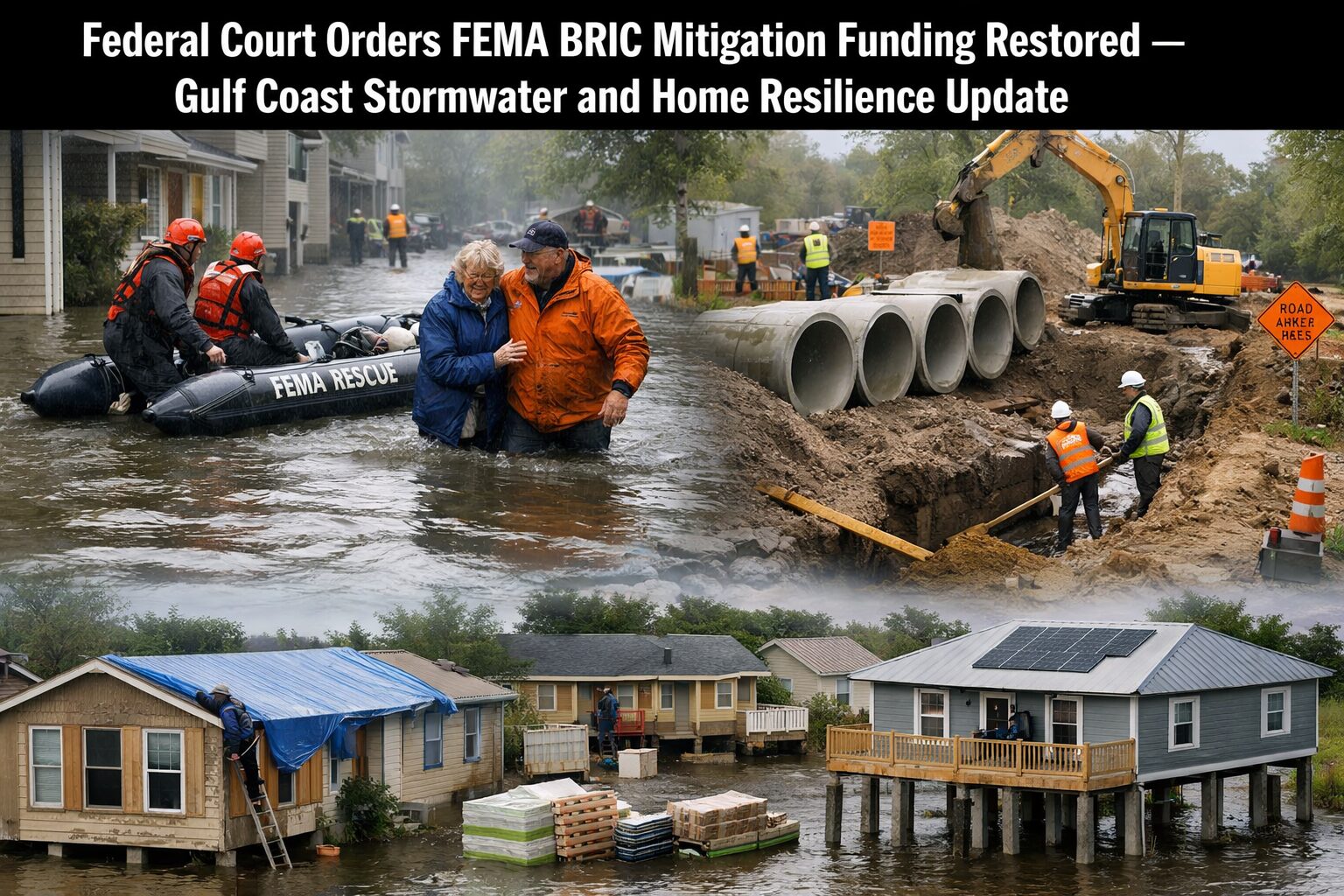
Federal Court Orders FEMA to Restore BRIC Mitigation Funding — What It Means for the Gulf Coast
In December 2025, a federal court ordered the restoration of FEMA’s Building Resilient Infrastructure and Communities (BRIC) mitigation funding. BRIC is widely known for supporting pre-disaster projects that reduce community risk before the next storm hits — including stormwater drainage improvements, infrastructure hardening, and other resilience upgrades.
For homeowners across the Gulf Coast, the significance is simple: when communities can strengthen drainage and resilience systems, it helps reduce repeat flooding patterns, standing water issues, and neighborhood-level damage that often compounds roof, siding, and exterior wear over time.
What Is the FEMA BRIC Program?
BRIC is a FEMA program focused on helping communities invest in resilience before disasters occur. Rather than waiting for damage and relying only on post-storm repairs, BRIC funding is designed to support projects that lower long-term risk and reduce the cost of future losses.
While the funding is awarded to communities and agencies — not individual homeowners — the results can directly affect neighborhoods by improving stormwater flow, reducing recurring infrastructure failures, and strengthening systems exposed to severe weather.
Why the Court Decision Matters
This restoration matters because BRIC projects often sit in the “prevention gap” — the space between what homeowners can do on their own property and what requires larger public infrastructure upgrades. When mitigation funding is delayed or canceled, drainage and flood-prevention plans can stall, and neighborhoods stay vulnerable to repeat storm impacts.
What Types of Projects BRIC Often Supports
In practice, BRIC-related investments usually target the kinds of problems Gulf Coast residents recognize immediately after heavy rain or tropical weather. Common project categories include:
- Stormwater drainage upgrades and overflow prevention
- Hardening critical infrastructure against severe weather impacts
- Neighborhood-scale flood risk reduction strategies
- Improvements that reduce repetitive loss patterns over time
Even when a storm does not reach hurricane strength, the Gulf Coast can experience intense rainfall and short-duration flooding. That is why drainage improvements and runoff control remain a major part of real-world resilience.
What Homeowners Can Do While Communities Work on Mitigation
Infrastructure funding decisions happen at the city or state level, and timelines can vary. The fastest improvements homeowners can make are typically the ones tied to water control, roof detailing, and preventive maintenance — because these reduce the amount of storm stress your home absorbs in the first place.
Practical steps that often provide real-world benefit include:
- Confirm gutters, downspouts, and discharge points move water away from the slab and foundation
- Check roof perimeter details (drip edge, fascia transitions, and edge sealing) for wind-driven rain exposure
- Inspect soffit and attic ventilation for moisture control in high-humidity conditions
- Address small leak patterns early before decking and framing become involved
- Document recurring water issues so the root cause is easier to identify and solve
These are not “one-size-fits-all” upgrades, but they are consistent pain points we see across Louisiana and Mississippi — especially after repeated seasons of heavy rain and strong wind events.
Why This Is a Gulf Coast Conversation, Not Just a Policy Headline
On the Gulf Coast, weather damage is rarely caused by one single issue. It is usually a chain reaction — runoff that overwhelms drainage, water that stays trapped near the structure, wind-driven rain finding weak edges, and humidity accelerating deterioration. When community mitigation projects move forward, they help reduce the pressure on homes during every storm cycle.
But homeowners still benefit most when neighborhood-level resilience is paired with home-level protection — especially roof and water-management improvements that make your home harder to damage in the first place.
FAQ
Does BRIC funding go directly to homeowners?
No. BRIC is typically awarded to communities, agencies, or organizations for mitigation projects. Homeowners benefit indirectly through improved infrastructure and risk reduction.
What does this mean for flooding and drainage issues?
Many BRIC projects focus on stormwater and resilience improvements. When these projects move forward, it can help reduce repeat overflow patterns and the neighborhood-level factors that drive frequent water problems.
Should I wait for infrastructure improvements before fixing my home?
Most homeowners should not wait. Basic water control, roof perimeter details, and preventive inspections can reduce damage risk right now, regardless of when larger community projects are completed.
If you want a storm-ready plan for your roof, gutters, or exterior water control, Southern Home Improvement Center (SHIC) can help you identify the highest-impact improvements for your specific home. Call (225) 766-4244 or (985) 643-6611 to schedule an inspection and receive a clear, itemized proposal.


