
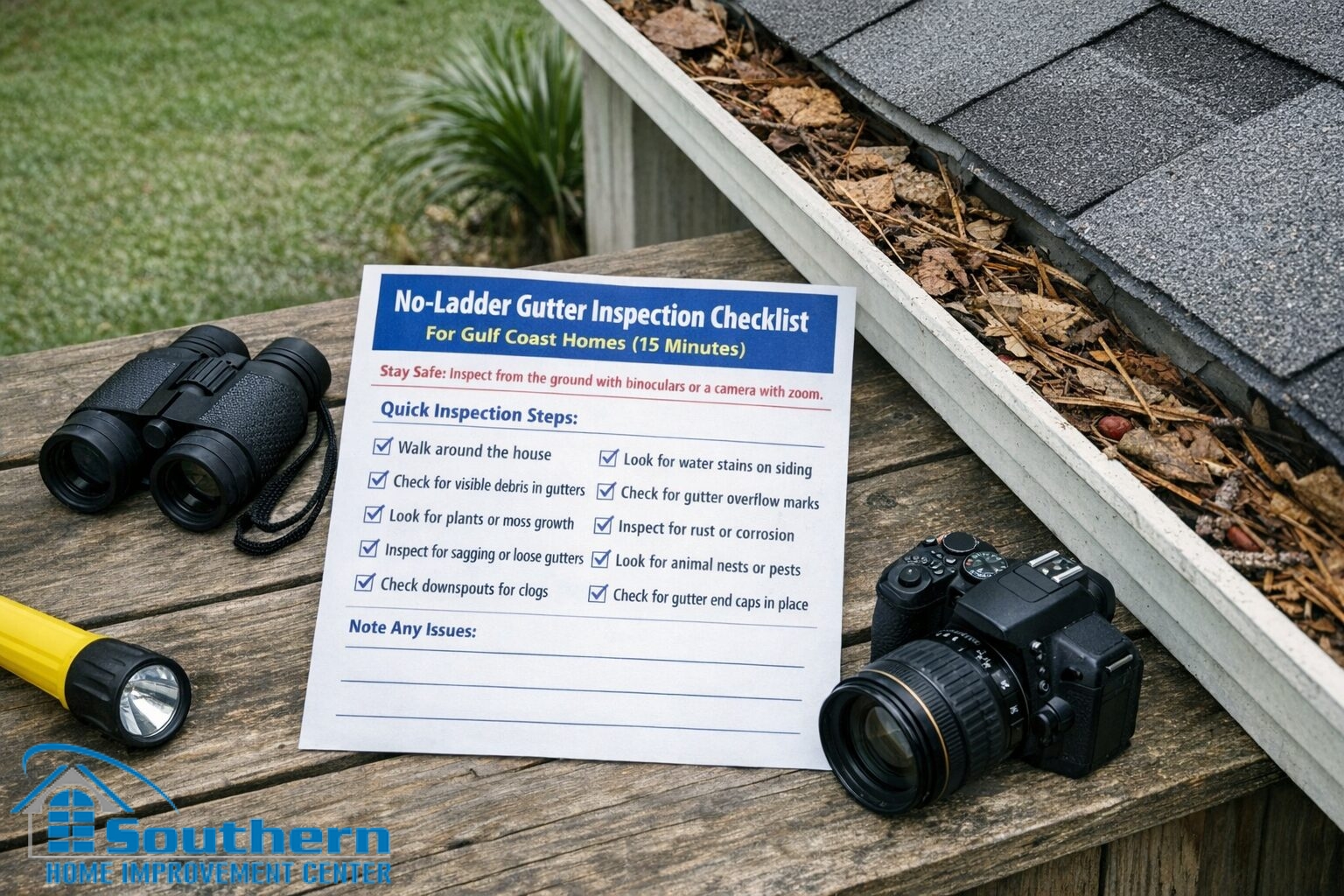
The No-Ladder Gutter Check: A 15-Minute Drainage Inspection for Gulf Coast Homes
Gutters and downspouts are a simple system, but on the Gulf Coast they take a beating from heavy rain, wind-driven debris, and fast weather swings. When they fail, the symptoms show up quickly: overflowing water, stained fascia, soggy landscaping, and puddling near the foundation. This guide is designed for homeowners in Southeast Louisiana and the Mississippi Gulf Coast who want a safer, from-the-ground inspection that produces clear, useful notes for a contractor.
What this quick check can catch early
Practice shows most drainage problems fall into a small set of repeat patterns. Use this check to spot the common ones before they turn into wood rot, hidden leaks, or soil erosion:
- Overflow in heavy rain even when gutters look “mostly clear” from below
- Leaking seams and corners at joints, end caps, and miters
- Sagging sections that hold standing water after the storm passes
- Gutters pulling away from fascia or fasteners that have loosened
- Downspout blockages that force water to spill over the front edge
- Bad discharge where water dumps too close to the foundation
The goal is not to “DIY-fix” everything. The goal is to identify which failure pattern you have, document it clearly, and know when it is time to bring in a pro.
The 6-photo checklist you can do from the ground
If you take the right six photos, a gutter contractor can often triage the problem faster and more accurately. Walk the perimeter and capture:
- One straight-on roofline shot of each gutter run (helps reveal sagging and low spots)
- Every corner/miter where leaks commonly start
- Each end cap (drips and streaks are a red flag)
- Each downspout inlet at the gutter drop
- Each downspout outlet at ground level (where water actually goes)
- Any staining on fascia/soffit/siding directly below the gutter edge
After you take the photos, note which side of the home each one belongs to (front, left, right, rear). That small step prevents confusion when scheduling service.
The “rain test”: what to watch during a downpour
Gulf Coast storms are the perfect stress test. You do not need a ladder to learn a lot during active rainfall. From a safe covered spot, watch for:
- A front-edge “waterfall” instead of water staying inside the gutter channel
- Jetting at seams (a thin stream shooting from a joint indicates a leak point)
- Backflow behind the gutter line toward fascia
- One downspout doing all the work while others appear inactive
If a section overflows immediately in moderate rain, treat it as a priority. That usually indicates a blockage, a slope problem, or a restricted downspout.
Downspouts: the most ignored failure point
Many homeowners focus on “dirty gutters” and miss the real bottleneck: downspouts and their discharge. A practical rule used in inspection guidance is that downspouts should divert water several feet away from the foundation. If water is dumping right at the base of the wall, erosion and puddling become much more likely.
Look at the outlet area after rain. If you see a trench forming, mulch washing away, or persistent puddles, the discharge location and grading should be reviewed — even if the gutter itself seems fine.
Why gutters overflow even when they look clean
If you are seeing overflowing gutters in heavy rain, it is often one of these scenarios:
- Hidden clogs at the downspout drop, elbows, or underground drain connections
- Improper pitch where the gutter is not sloped correctly toward the downspout
- Low spots from sagging hangers that hold standing water
- Undersized or restricted flow path when debris collects in a narrow section
- Fast runoff volume during intense rain bursts that exceed what a compromised system can move
The key diagnostic clue is consistency. If the same area overflows repeatedly, it is usually a slope, hanger, seam, or downspout issue — not a “one-time storm” problem.
Gutter guards: what they solve (and what they don’t)
Gutter guards can reduce the amount of debris that enters the channel, which helps many homes. But they do not eliminate the need to inspect the system, especially after major storms.
- Guards can help with leaf and larger debris load in certain conditions
- Guards do not help if the pitch is wrong, hangers are failing, or seams are leaking
- Guards can hide problems if you never check corners, end caps, and downspout performance
If you have guards and still see overflowing gutters in heavy rain, focus on downspouts, pitch, and leak points rather than assuming “the guards didn’t work.”
A simple maintenance rhythm that actually gets done
Instead of trying to over-engineer a schedule, use a realistic rhythm that fits Gulf Coast weather. The easiest approach is to do short checks at predictable times and quick follow-ups after major storms.
- Routine check a couple of times per year (photos + downspout outlets)
- Storm follow-up when you notice overflow, staining, or new puddling
- Targeted service for the repeat trouble spots (same corner, same run, same outlet)
If you document the repeat trouble spots, most gutter work becomes more efficient — and the fixes tend to last longer because they address the underlying pattern.
When to call a pro
It is time to schedule a gutter contractor if you notice any of the following:
- Gutters pulling away from fascia or visibly separating along the run
- Sagging sections that hold water after rain stops
- Persistent leaking at seams, corners, or end caps
- Overflow that repeats in the same place in normal rainfall
- Downspouts that do not discharge clearly during rain
- Staining or moisture marks on fascia, soffit, or siding below the gutter edge
- Soil erosion, trenches, or puddling near the foundation line
If you want an expert look at the full drainage picture — gutters, fascia, soffit, and water routing — it helps to work with a local team that understands Gulf Coast rainfall patterns and storm after-effects.
Learn more about our gutter services at seamless gutters in Southeast Louisiana, or use this checklist to share the exact photos and symptoms you are seeing when you request service.
FAQ
How often should I check gutters and downspouts?
A simple approach is to do a short perimeter check a couple of times per year, then add a quick follow-up after major storms or whenever you see overflow, staining, or puddling. Consistency matters more than perfection.
Why do gutters overflow in heavy rain?
Overflow usually points to a restriction at a downspout drop, an elbow clog, improper pitch, a sagging low spot, or a leak point that disrupts flow. Repeating overflow in the same location is a strong clue that the issue is structural — not random.
How do I know a downspout is clogged?
During rainfall, a clogged downspout often shows “silent” outlets, water spilling over the gutter edge near the drop, or water backing up at seams. After rain, look for puddling and erosion near the outlet.
Do gutter guards eliminate maintenance?
No. Guards can reduce debris entry, but they do not fix pitch problems, failing hangers, or leaking seams. You still want to inspect corners, end caps, and downspout performance.
When should I call a contractor instead of trying to troubleshoot it myself?
If gutters are pulling away, sagging, leaking at multiple points, or repeatedly overflowing, the fastest path is usually professional inspection and repair. That is especially true when water is dumping near the foundation or staining fascia and soffit.
If you would like a professional gutter and drainage inspection, call Southern Home Improvement Center (SHIC) at (985) 643-6611 (Slidell / Northshore) or (225) 766-4244 (Baton Rouge) to request a free estimate.


