
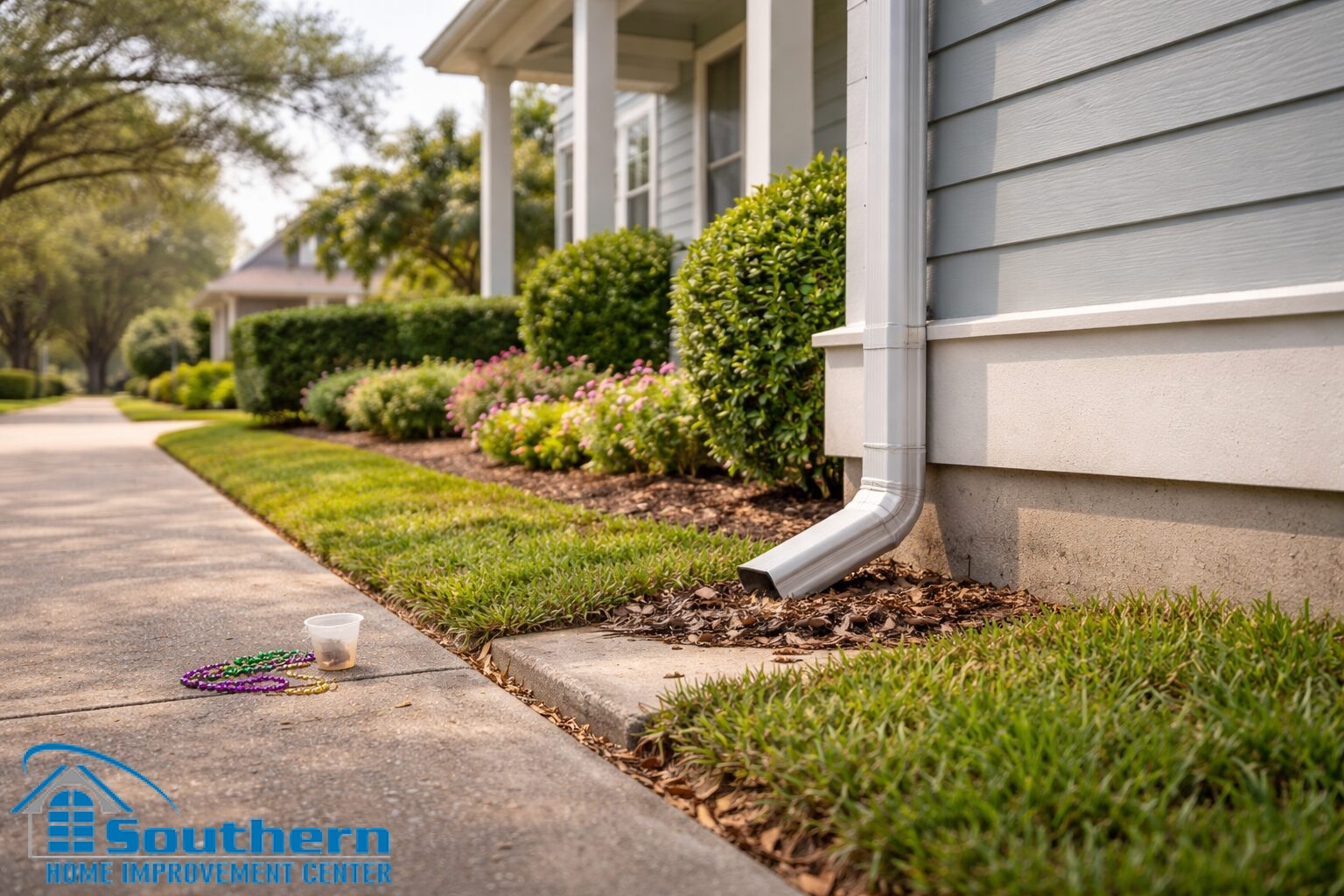
Post-Mardi Gras 15-Minute Exterior Check for Louisiana and Mississippi Homes
Mardi Gras is over. Before life gets busy again, take 15 minutes for a quick, ground-level exterior check. Parade debris, wind, and late winter fronts can create small problems that quietly become water intrusion — and the earlier you spot them, the easier they are to fix.
This is not a full inspection. It’s a simple walk-around designed to help you notice obvious red flags, take a few photos, and decide whether you can monitor it or should schedule a professional evaluation.
Safety first (seriously)
Keep this check ground-based. Do not climb ladders or walk a roof unless you’re trained, equipped, and completely comfortable. Many warning signs are visible from the driveway, yard, and door thresholds — and it’s never worth risking a fall for a closer look.
The 15-minute walk-around checklist
Start at the front door, walk the perimeter once, then finish with a quick look at the areas where water typically shows up first. Use your phone flashlight if you’re checking shaded corners.
- Debris at the roofline: look for branches, pine needles, parade cups, and leaves collecting at valleys, low roof edges, and gutter sections.
- Gutters and downspouts: check for visible clogs, sagging runs, stains on fascia, or “water lines” where overflow has been happening.
- Downspout exits: confirm water has a clean path away from the home — not dumping at the slab edge or pooling near the foundation.
- Roof edge alignment (from the ground): scan the eaves and rakes for anything lifted, uneven, or missing.
- Soffit and fascia: look for gaps, soft-looking areas, peeling paint, new staining, or sections that appear to have shifted after wind.
- Windows and trim: check exterior corners and sills for fresh water marks, swelling, peeling paint, or separated caulk lines.
- Exterior walls: note cracks, new separations at joints, and any area that suddenly looks “open” compared to last month.
- Ground drainage: after rain, look for standing water near the slab edge and places where runoff concentrates.
- Quick interior clue (optional): if you have safe access, look for new ceiling stains near exterior walls, around fireplaces, or under roof valleys.
Gutters and downspouts: the fastest wins
After Mardi Gras, gutter trouble is common because debris doesn’t need to fully block a system to cause damage. A partial clog can force water to overflow at corners, splash back onto fascia, and run behind trim where you won’t notice until staining appears.
If you’re seeing overflow marks or clogs, start with the basics: clear visible debris from ground level where possible, and confirm downspouts aren’t blocked at the outlet. For a deeper overview of what a properly sized, storm-ready setup looks like, see Seamless Gutters in Southeast Louisiana.
If the problem keeps repeating (even after cleaning), it’s usually a capacity or outlet issue — not just “needs cleaning again.” This guide explains practical fixes like outlet changes and downspout upgrades: Stop Gutter Overflow — Downspout Upgrades & Outlet Fixes.
Roof edges and early leak clues
Wind-driven rain doesn’t need a dramatic hole to get inside. Small shifts at edges, flashings, and transitions can let water in during the right storm angle. Your goal during a quick check is to spot anything that looks “off” and document it — not to diagnose it on the spot.
What to watch for from the ground:
- Lifted or uneven edge lines along eaves and rakes
- Missing or slipped pieces you can clearly see from the yard
- Fresh staining on soffit/fascia or around exterior corners
- New interior marks that appear after a rain event
If you suspect roof damage or you’re seeing active water signs, a photo-documented evaluation is the clean next step: Roof Damage Inspection & Insurance Docs. If your situation is clearly storm-related and needs a broader restoration plan, this overview lays out the process: Storm Damage Roof Restoration in Louisiana & Mississippi.
Soffit and fascia: where overflow turns into rot
Homeowners often notice fascia staining or soft-looking soffit panels after the fact — especially when gutters overflow during heavy rain bands. These areas matter because they’re part of the “roof edge system” that controls water and supports ventilation behavior at the eaves.
If you’re unsure what you’re looking at (or what “normal” should be), this guide explains common failure patterns and practical next steps: Soffits and Fascia: Repair, Replacement & Soffit Ventilation in Louisiana.
Windows and trim: leak, splash, or condensation?
Post-event checks often reveal water staining around window trim or at exterior corners. Sometimes it’s a true leak path. Other times it’s overflow splashback, failed sealant, or humidity/condensation patterns that look like leaks.
If you’re trying to separate “condensation symptoms” from real water entry, use this diagnostic guide as a reference: Window Leaks & Condensation: Causes and Fixes.
What to document (so you don’t have to guess later)
When you find something questionable, take 60 seconds to document it properly. That small habit saves time if you need to bring in a pro or compare changes after the next storm.
- Two photos: one wide shot (context) and one close-up (detail)
- Location note: “back right corner,” “front left eave,” “above garage,” etc.
- Timing: “noticed after rain,” “noticed after wind,” “appeared this week”
- Any repeat pattern: does it show up only with wind-driven rain from one direction?
If you want a more detailed, homeowner-friendly walkthrough you can reuse year-round, this is a strong companion piece: The 15-Minute Roof & Exterior Checkup Every Homeowner Can Do.
When it’s time to schedule a professional look
Use this simple decision rule: if a symptom is active, repeating, or spreading, it deserves a qualified evaluation. Examples:
- Active dripping or fresh interior staining
- Persistent gutter overflow marks and recurring clogs
- Soft-looking fascia/soffit areas or new gaps at the roofline
- Trim swelling, peeling, or repeated water marks after rain
If you’d like a no-pressure assessment and clear next-step guidance, contact Southern Home Improvement Center (SHIC) here: Contact SHIC. You can also call (985) 643-6611 (Slidell / Northshore) or (225) 766-4244 (Baton Rouge) to schedule.