
Roof Estimate Decoder (2025): Compare Roofing Quotes in 30 Minutes — Line by Line
When you request three roofing quotes and all three look different, it’s hard to tell which one is accurate, which one is padded, and which one is simply missing critical work. This guide shows U.S. homeowners how to read a roof estimate line by line, compare apples to apples, and flag red flags before you sign.
If you’re in Louisiana or the Mississippi Gulf Coast and want a photo-rich, itemized proposal, start with our Free Estimate. We’ll document your roof, explain options, and put everything in writing.
Use the quick navigation below to jump to any section. It outlines what a professional roof estimate should include, price context for 2025, and a checklist you can use to compare bids fast.
Each section below includes plain-English explanations and practical next steps, so you can evaluate quotes without guesswork.
What a Proper Roofing Estimate Should Include
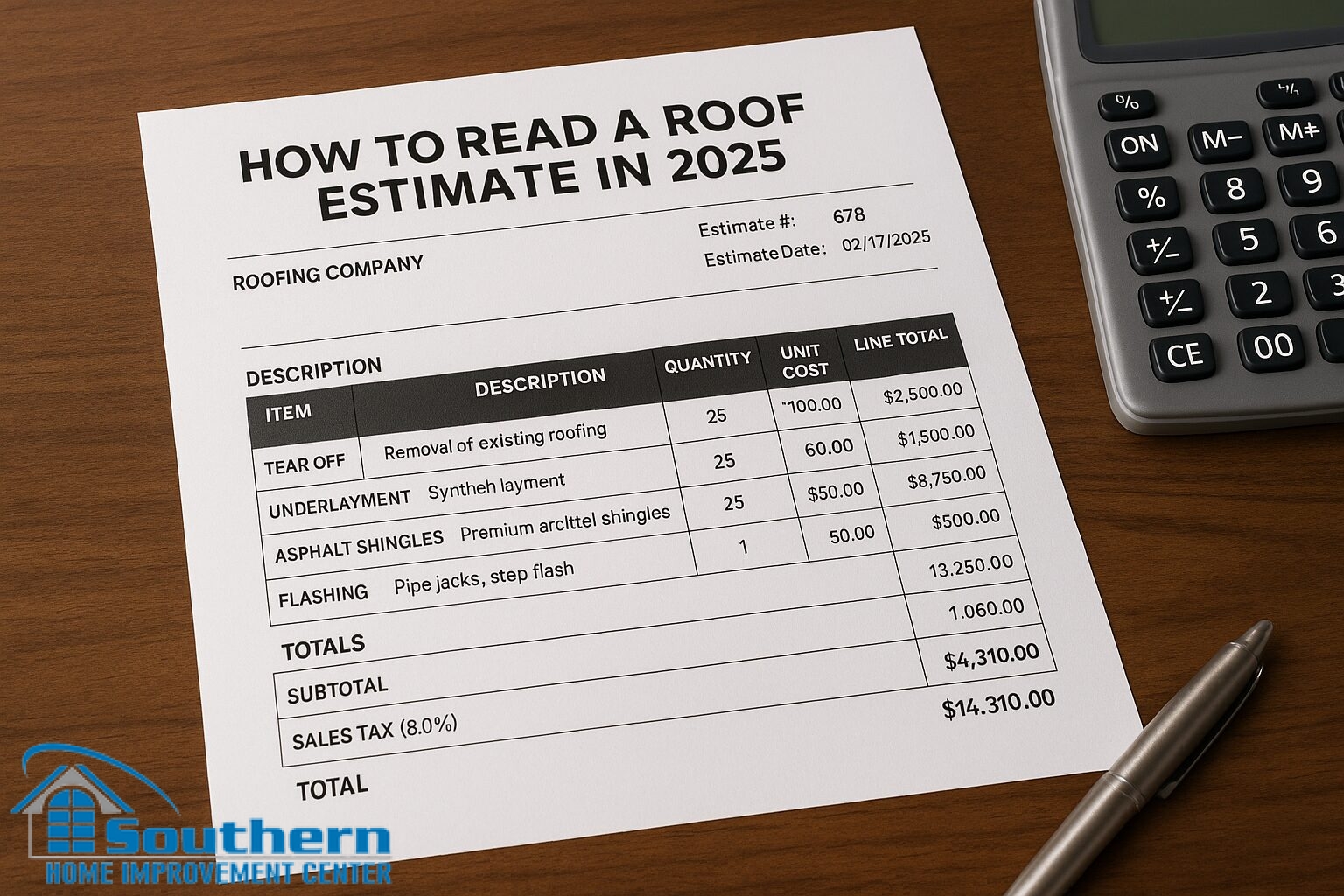
A legitimate proposal isn’t a single number. It should spell out materials, methods, labor, cleanup, permits, and warranties in writing. Items should be specific enough that another contractor could build the same roof from the document.
- Complete tear-off (how many layers) and deck prep, including per-sheet pricing for rotten sheathing.
- Underlayments by type and location (self-adhered at eaves/valleys/penetrations + synthetic over the field).
- New flashings and pipe boots, not just “sealant.” Kick-out flashing where a roof meets a wall.
- Ventilation plan with target intake/exhaust net free area (soffit + ridge or a code-compliant alternative).
- Shingle line, color, wind rating, and nailing pattern (e.g., architectural shingles, high-wind fastening).
- Edges and water management: drip edge, starters, valley method, and any gutter coordination.
- Cleanup, debris haul-off, daily site protection, permits, licensing/insurance proof, and warranties.
If any of these are missing, ask the contractor to revise the scope so you can compare bids fairly. For edge details and why they matter, review our Southshore Roof Perimeter Playbook.
2025 Price Reality Check (National Ranges)
National cost guides place an average full asphalt-shingle replacement in the high-$9k to low-$10k range, with wide swings for roof size, pitch, stories, complexity, and region. Coastal labor, storm-resistant assemblies, and steep/complex roofs skew higher. For Louisiana context, see our pages on roof cost drivers and the Roof Replacement & Installation hub.
The Line-Item Breakdown (and What to Look For)
Read this once before you compare numbers. These components determine performance, warranty validity, and long-term maintenance — not just the initial price.
Tear-Off & Deck Prep
A strong proposal states full tear-off vs. overlay, how many layers are coming off, how soft spots will be handled, and the per-sheet price for decking replacement. Overlays on already-layered roofs are a red flag for future leaks and warranty issues.
Underlayments (Water-shed & Self-Adhered)
Storm country typically needs two layers: a self-adhered membrane at eaves, valleys, and penetrations, and a synthetic underlayment over the field. The estimate should call out brands or ASTM performance classes and the exact coverage locations.
Flashings & Penetrations
This is where many leaks start. Look for new pipe boots, step and counter-flashings at walls, and kick-out flashings where roofs meet sidewalls. “Sealant only” is not a long-term fix. For diagnosing post-storm leaks, see Wind-Driven Rain vs. Roof Failure.
Ventilation Plan
Balanced intake (soffits) and exhaust (ridge) protects shingles, reduces heat load, and keeps warranties valid. Good estimates state the target NFA, where vents will be added/cleared, and how box vents or fans (if any) will be handled. Use our explainer to sanity-check numbers: Attic Ventilation in Louisiana.
Shingles & Nailing Method
Expect product line, color, wind rating, and fastening method in writing. If you’re comparing impact-rated options, understand the difference: Class 4 is the top UL 2218 impact rating; Class 3 is lower. No shingle is invincible, but ratings help compare apples to apples.
Water Management at Edges
Drip edge orientation, starter courses, and valley treatment matter as much as the shingles. If your home overflows gutters even when clean, the estimate should address downspout count and outlet sizing or coordinate a gutter upgrade. See our guides to seamless gutters and 6-inch vs. 7-inch systems.
Cleanup, Safety & Site Protection
Professional crews explain how they protect landscaping, conduct magnet sweeps, manage debris, and handle disposal fees. You should also see a daily cleanup plan and final walkthrough language.
Permits, Licensing & Insurance
Reputable contractors include permit handling, license numbers, and proof of liability and workers’ comp. This protects you legally and financially.
Warranties (Material & Workmanship)
Clarify manufacturer vs. contractor coverage, transferability, wind/hail exclusions, and what voids them (e.g., inadequate ventilation or multiple recover layers). Ask how claim support works if something fails.
Schedule, Access & Payment Terms
Look for expected start/finish windows, a clear change-order process, and a fair payment schedule (deposit, progress, balance on completion after walkthrough). Anything vague here leads to friction later.
The 30-Minute Side-by-Side Checklist
Use the sections below to compare three estimates quickly. If any item is blank or vague, request a revision before you choose. The goal is apples-to-apples scope and pricing.
Scope & Prep
Confirm that tear-off and deck prep are defined, and that underlayments are matched to local weather and code.
- Tear-off layers stated and deck repair price per sheet listed.
- Self-adhered membrane located at eaves/valleys/penetrations; synthetic underlayment over the field.
- Perimeter details coordinated with gutters, drip edge, and starters.
If these are missing or vague, ask for a written revision that spells out products and locations.
Flashings & Penetrations
Most callbacks trace to weak flashing language, not the shingles themselves.
- New pipe boots, step/counter-flashings, and kick-outs are included.
- Chimney/skylight details go beyond “sealant”; metal and sequencing are defined.
- Wall transitions describe removal/replacement, not reuse of failing parts.
When in doubt, request photos of existing conditions and how each area will be rebuilt.
Ventilation
Attic airflow affects shingle life, energy use, and moisture risk. Numbers, not guesses, should drive the plan.
- Target NFA (intake + exhaust) is shown with counts/locations.
- Old box fans capped or removed; ridge vent and soffit intake balanced.
- Blocked soffit bays cleared during the project, not “later.”
For the math behind balanced systems, see our ventilation guide.
Shingles & Fastening
Product transparency prevents bait-and-switch and protects your warranty.
- Shingle line, color, wind rating, and nailing pattern listed.
- Impact rating (Class 3 or Class 4) noted if you requested it.
- Starter and hip/ridge components matched to the field shingle.
Ask for a sample board to confirm texture, blend, and color in natural light.
Edges & Water Management
Edges are where wind-driven rain tries to sneak in. Good plans control water before it becomes a leak.
- Drip edge orientation, starter courses, and valley method are defined.
- Gutter/downspout changes listed if overflow or staining is a concern.
- Kick-out flashings placed where roofs die into sidewalls.
For a deeper dive into edge sequencing, study the Perimeter Playbook.
Logistics, Protection & Terms
Clear logistics reduce surprises, keep crews moving, and protect your property.
- Permits handled by the contractor; license and insurance proof provided.
- Daily cleanup plan, debris haul-off, and magnet sweep listed.
- Payment schedule and change-order process explained.
Save a copy of the final scope and photos; they’re useful for warranty or insurance later.
BOOK YOUR FREE ESTIMATE
Certified FORTIFIED™ installations, hurricane-rated materials,
backed by lifetime workmanship warranty.


Only 3 appointment slots left this week • BBB A+ Rated • 120+ 5-Star Reviews
How to Spot “Too Cheap to Be True”
If a bid is 25–40% below the others, it often omits labor-heavy items (tear-off, flashings) or hides them in vague language like “as needed.” Cross-check scope first, then compare line-item pricing. National ranges help you spot outliers, but scope parity is the key.
When Insurance Is Involved
Storm claims add adjusters, scopes, and supplements. A claim-savvy roofer aligns the estimate to the insurer’s format and documents real construction steps with photos and code references. If you’re opening or disputing a claim, bookmark our guide: Roof Insurance Claims — Louisiana & Mississippi.
Should You Upgrade to Class 4 Impact-Rated Shingles?
In hail-prone regions, Class 4 shingles can reduce future repairs and sometimes qualify for insurance incentives. The rating comes from UL 2218 (steel-ball impacts). No shingle is invincible in extreme events, but Class 4 performs better than Class 3. Ask your insurer about potential discounts and weigh them against the premium.
Don’t Forget Gutters & Ventilation
Many “mystery leaks” are edge mistakes or trapped attic moisture. Coordinating gutters and ventilation during a reroof solves two problems with one mobilization. For Gulf-ready water paths, see Seamless Gutters and our 6-inch vs. 7-inch comparison; for attic airflow, review Attic Ventilation in Louisiana.
Quick Math: Are You Comparing the Same Roof?
Before choosing, confirm that every bid uses the same roof area (squares), the same number of layers to remove, and the same material tier. If one proposal includes full flashing replacement and another says “reuse existing,” you’re not evaluating the same project.
Example: How We Present Bids
Transparency reduces surprises. Our proposals include photos, a clear scope, options, and written terms so you know exactly what you’re buying.
- Annotated photos of trouble spots (deck rot, failing flashings) and measurements.
- Scope that spells out underlayments, flashings, ventilation, and edge metals.
- Good / Better / Best options with line-item pricing for each tier.
- Timeline, cleanup, and warranty terms in writing.
You can preview our approach on the Roof Replacement & Installation hub and the Southshore Roof Perimeter Playbook.
Bonus: Cost & Value Perspectives
If you’re thinking about resale, national remodeling research shows roofing often recoups a meaningful portion of cost at sale, with wide variation by material and market. Treat those reports as context, not a quote; your local labor, material choice, and roof complexity drive the real number.
Final Step: Get a Comparable, Photo-Rich Estimate
Ready to compare quotes the right way? We’ll measure your roof, photograph key details, and deliver a clear, itemized proposal you can stack against any bid. Start here: Free Estimate — or call our local teams at (985) 643-6611 for Slidell/Northshore and (225) 766-4244 for Baton Rouge.


